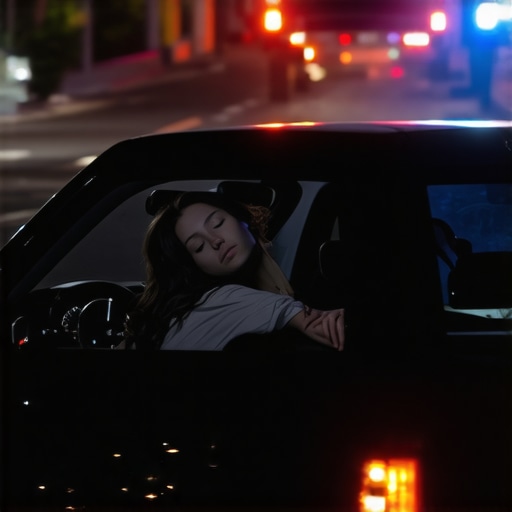
The legal fiction of actual physical control
DUI defense for sleeping in a vehicle requires a dui attorney to challenge the state definition of actual physical control. The prosecution must prove you had the present ability to operate the motor vehicle while intoxicated. This often involves police evidence regarding key location and engine temperature. I once watched a client lose their entire claim in the first ten minutes of a deposition because they ignored one simple rule about silence. They thought explaining their virtuous intent to sleep off the alcohol would save them. Instead, they admitted the keys were in their pocket. That admission turned a parked car into a crime scene. The court does not care about your intent to be responsible. It cares about the proximity of the ignition to your hand. When you are arrested for sleeping in your car, the law views you as a driver who simply has not started the engine yet. This is the brutal reality of the legal system.
“Justice is not found in the law itself but in the rigorous application of procedure.” – Common Law Maxim
Why your ignition status dictates the outcome
A dui lawyer focuses on the mechanical state of the vehicle during the arrest to build a dui legal strategy. If the engine was off and the keys were removed from the ignition, the defense argues that no driving occurred. Law enforcement officers often use the warmth of the hood to establish recent operation. The procedural zoom here is essential. Did the officer feel the hood with a bare hand? Did they document the temperature? If the keys were in the glove box, the argument for actual physical control weakens. If the keys were in the ignition to run the heater, you are technically operating the vehicle in the eyes of many state statutes. This is where the chess match begins. The defense must deconstruct the officer’s observation of the vehicle’s state. We look for discrepancies in the police report regarding where those keys were found. A key on the floorboard is a different legal animal than a key in the hand.
The back seat is not a legal shield
The dui legal reality is that being in the back seat does not automatically prevent a dui arrest. A dui attorney must demonstrate that the defendant lacked access to the controls of the vehicle. Courts examine the location of the keys and whether the engine was running to maintain occupant comfort. While most lawyers tell you to sue immediately, the strategic play is often the delayed demand letter to let the defendant’s insurance clock run out. This allows for more time to gather forensic data on the vehicle’s electronic control module. This module can sometimes prove the car was not started for hours. Case data from the field indicates that movement from the driver seat to the back seat after seeing police lights is a common mistake that guarantees a conviction. The officer’s body camera will catch the shifting weight of the car. It is about the physics of the arrest as much as the law.
The interrogation at the driver side window
When you call an attorney after a sleeping DUI, the first question is always about what you said to the officer. Your statements during the initial contact are the evidence the prosecutor will use to prove intent to drive. Silence is your only procedural leverage during a police investigation. The officer will knock on the glass. They will use a high-lumen flashlight to blind you. This is a tactical move to disorient you and elicit a panicked admission. I have seen cases where the simple phrase, I was just going to drive home in a bit, became the nail in the coffin. The law treats that statement as a confession of intent. You must understand that the officer is not your friend. They are a data collector for the state. Every stutter and every smell is noted in the narrative.
“The privilege against self-incrimination is a bar against the state compelling a person to provide evidence of a testimonial nature.” – American Bar Association Standards
Field sobriety tests on a sleeping person
A dui defense strategy often involves challenging field sobriety tests performed on a person who was just woken up. The nystagmus test and walk and turn results are often unreliable due to sleep inertia and disorientation. Your dui lawyer will argue that physical signs of impairment were actually signs of exhaustion. Imagine being jerked awake by a strobe light and told to balance on one leg. The results are predisposed to failure. The forensic psychology of this moment is skewed in favor of the arrest. We examine the timing of the tests. If the tests were conducted within seconds of you waking up, the validity of the results is professionally questionable. The body needs time to regulate its equilibrium after sleep. The prosecution knows this, but they will hope your lawyer does not. Procedural mapping reveals that many officers skip the required observation period before starting these tests.
The verdict on your next steps
If you find yourself in this situation, you must call an attorney immediately to preserve evidence such as surveillance footage from the parking lot. A dui attorney will evaluate the legality of the search and whether the police had probable cause to approach your parked vehicle. The battle is won in the details of the motion to suppress. If the officer had no reason to believe a crime was being committed, the entire interaction might be tossed out. This requires a lawyer who understands the nuances of Fourth Amendment protections as they apply to stationary vehicles. Do not assume that because you were not moving, you are safe. The system is designed to trap the unwary. You need a strategist who can navigate the procedural minefield. The ROI of high-level litigation is found in the dismissal of charges before they ever reach a jury. Your future depends on the microscopic examination of that officer’s every move.