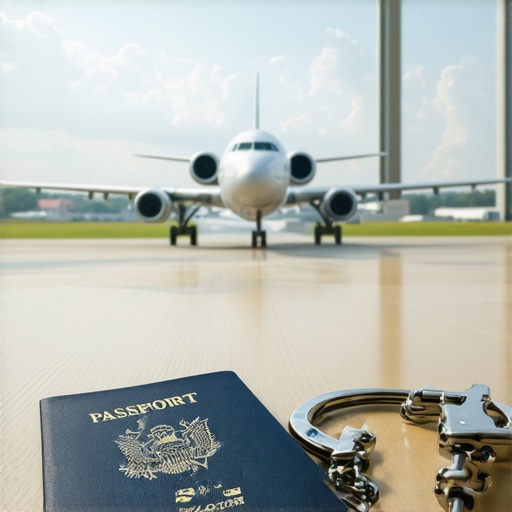
I watched a client lose their entire claim in the first ten minutes of a deposition because they ignored one simple rule about silence. They thought they could narrate their way out of a mistake. They spoke when they should have listened. Now they sit across from me with a cold cup of black coffee, wondering why the border agent in Vancouver just handed them a turnaround order. Your arrest is a digital ghost. It does not stay in the police station. It travels to every port of entry before you even pack your suitcase. If you think a pending charge is just a local problem, you are dangerously mistaken. The legal reality of international travel after a brush with the law is a chess match where the board is rigged against the unprepared. This is the brutal truth about how a single night of bad decisions can shrink your world to the size of your own backyard.
Canada and the wall of criminal inadmissibility
The Canada Border Services Agency or CBSA maintains a zero tolerance policy for foreign nationals with an arrest record or DUI conviction. Under the Immigration and Refugee Protection Act, a simple drunk driving offense is classified as serious criminality. This means you are criminally inadmissible. If you attempt to cross the border with a pending case, you will likely be denied entry and sent back to the United States immediately. Many travelers believe they can simply not mention the incident. This is a strategic failure. The NCIC database used by the FBI is shared directly with Canadian authorities. They see what the dui attorney sees. They see the dui legal history the moment your passport is scanned. Even if your case was dismissed, the record of the arrest remains visible unless specific steps are taken to seal it. You might need a Temporary Resident Permit or Criminal Rehabilitation to enter, both of which require months of paperwork and significant legal fees. Information gain is found here: While most lawyers tell you to plea quickly to move on, the strategic play is the procedural stall to keep the conviction out of the database during a vital travel window.
“Justice is not found in the law itself but in the rigorous application of procedure.” – Common Law Maxim
The death of the Electronic System for Travel Authorization
The Electronic System for Travel Authorization known as ESTA is the privilege of visa free travel for citizens of specific countries. An arrest for a DUI or any crime involving moral turpitude ends this privilege permanently. Once you have been arrested, you can no longer truthfully answer no to the question regarding your criminal record on the application. A dui lawyer will tell you that lying on this federal form is a crime in itself. Once the ESTA is denied, you must apply for a B1 or B2 visa through a U.S. Consulate. This process involves a consular interview where a government official will scrutinize your dui defense and your current lifestyle. The Department of State has the absolute discretion to deny your visa based on INA 212. This is not a courtroom where you have the presumption of innocence. This is an administrative hurdle where the burden of proof is entirely on you to show you are not a risk to the host nation. Call an attorney before you click submit on any government travel form because one wrong checkbox can result in a lifetime ban from certain territories.
The medical exam trap at the consulate
If you are applying for a visa after a DUI arrest, the consulate may trigger a medical examination requirements under CDC guidelines. The government looks for signs of alcoholism or a mental disorder with associated harmful behavior. You will be sent to a panel physician who will evaluate your dui legal history and your current health. If the doctor finds evidence of habitual intoxication, you are barred from entry. This is a clinical assessment that has nothing to do with your guilt or innocence in a court of law. It is a forensic health check. Many individuals believe that a dui lawyer can argue them out of this. They cannot. Once the medical flag is raised, you are trapped in a medical waiting period that can last for years. The strategic maneuver is to secure a rehabilitation certificate or medical clearance from your own specialists before the consulate even asks for it. This proactive approach is the only way to counter the clinical bias of the government doctors. You must treat the medical exam with the same tactical precision as a cross examination.
“The right to travel is a liberty that cannot be inhibited without the due process of law.” – Kent v. Dulles, 357 U.S. 116 (1958)
Revocation of Global Entry and TSA PreCheck status
The Trusted Traveler Programs like Global Entry and TSA PreCheck are based on the concept of low risk. An arrest, regardless of the final court outcome, often results in the immediate revocation of these privileges. The Customs and Border Protection agency or CBP conducts regular background checks on all members. A dui attorney can help you appeal a revocation, but the success rate is low. The government views these programs as a privilege, not a right. When you call an attorney, ask about the CBP Ombudsman process. There is a specific window for administrative appeals. If you miss this window, you will spend the rest of your life in the long security line. The dui defense in the criminal court is only half the battle. The other half is the administrative hearing to save your status. Most people ignore the letter from the DHS until it is too late. The loss of Global Entry is often the first sign that your arrest record has been fully integrated into the global security matrix. Do not wait for the notification to arrive. Assume the government is already moving to strip your access.
The hidden costs of international background checks
Many countries now require police certificates for long term stays or work visas. A DUI on your record will appear on an FBI Identity History Summary. This dui legal footprint can prevent you from obtaining residency in countries like Australia, New Zealand, or the United Kingdom. Each country has its own threshold for what constitutes a serious crime. In some jurisdictions, a single drunk driving incident is enough to label you a person of bad character. When you call an attorney, you must discuss the long term immigration consequences of a plea deal. A conviction that looks like a win in a local court might be a total loss for your international career. The dui defense must be tailored to the specific immigration standards of the countries you frequent. This is the forensic reality of 21st century law. Your dui attorney must be a strategist who looks at the globe, not just the local docket. The world is getting smaller for everyone, but it gets much smaller, much faster, for those with a criminal record.