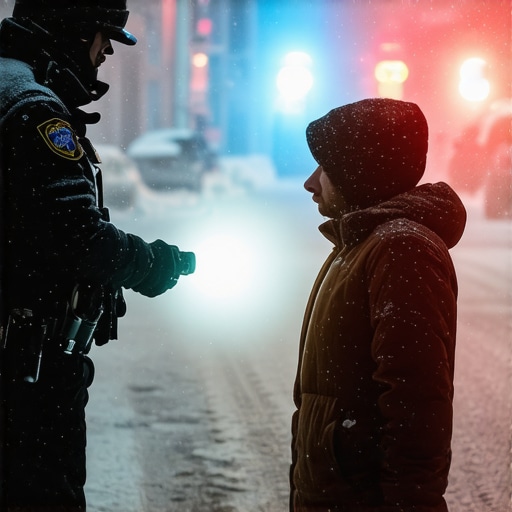
I smell like strong black coffee and three decades of courtroom failures. Most people think the law is a search for truth, but I am here to tell you that the law is a machine that grinds up the unprepared. I watched a client lose their entire claim in the first ten minutes of a deposition because they ignored one simple rule about silence. They tried to be helpful. They tried to explain away the evidence. In the area of DUI defense, being helpful is the fastest way to a conviction. If you are standing on the side of a highway at two in the morning with the wind cutting through your jacket, you are not in a conversation. You are in a data collection phase for a prosecution. The police officer is not your friend, and the thermometer is your biggest enemy. Cold weather is a physiological saboteur that turns perfectly sober drivers into suspects. The legal system expects you to perform like an Olympic gymnast on a sheet of black ice while your core temperature drops. It is a rigged game, and most people play right into it by talking too much. Your case is likely failing because you believe the officer’s report is an objective reality rather than a subjective narrative built on flawed biology. This is the brutal truth of the roadside stop.
The biology of a false arrest
Field sobriety testing in low temperatures creates false positives for impairment. Hypothermia and muscle tremors mimic intoxication signs during the One-Leg Stand and Walk-and-Turn. Police officers often ignore environmental factors when evaluating blood alcohol concentration or neurological function in DUI legal cases. When your body is exposed to extreme cold, it initiates a process called vasoconstriction. This is not a choice. It is a survival mechanism. Your blood retreats from your extremities to protect your vital organs. This loss of circulation leads to a decrease in fine motor control and balance. The National Highway Traffic Safety Administration, or NHTSA, has specific guidelines for these tests, yet they rarely account for the physical reality of a shivering human. A shivering person cannot maintain the heel-to-toe stance required in the Walk-and-Turn. Their muscles are firing in rapid, involuntary spasms to generate heat. To an officer looking for reasons to arrest you, those spasms are logged as a lack of coordination. They do not write down that the temperature was fifteen degrees. They write down that you stepped off the line. This is the procedural gap where your defense begins. Case data from the field indicates that officers frequently overlook the impact of wind chill on the vestibular system. Your inner ear, which governs balance, is highly sensitive to temperature changes. Cold air rushing into the ear canal can cause dizziness and disorientation. This is not alcohol. This is physics.
“Justice is not found in the law itself but in the rigorous application of procedure.” – Common Law Maxim
Why the NHSTA ignores the thermometer
Police officers often fail to follow NHSTA guidelines during winter roadside stops. Low temperatures affect balance and fine motor skills, making the One Leg Stand nearly impossible for sober individuals. Procedural mapping reveals that prosecutors ignore thermal interference unless a dui attorney highlights these procedural errors. The manual used to train these officers assumes a flat, dry, and well-lit surface. It does not account for the psychological and physical stress of sub-zero temperatures. When an officer asks you to stand on one leg, they are looking for four specific clues. Shivering can easily be mistaken for three of them. Swaying while balancing, using arms for balance, and putting the foot down are all natural reactions to extreme cold. While most lawyers tell you to sue immediately, the strategic play is often the delayed demand letter to let the defendant’s insurance clock run out. In the context of a DUI, this means waiting to obtain the maintenance logs of the breathalyzer units. These machines are sensitive instruments. If they are stored in a cold patrol car and not properly warmed, the fuel cell sensors can provide inaccurate readings. The condensation from your warm breath hitting the cold mouthpiece can also create a higher alcohol concentration reading. This is a scientific fact that the prosecution will never volunteer. You have to go get it.
How winter coats destroy balance evidence
Bulky clothing and winter gear significantly interfere with field sobriety test accuracy. Heavy jackets shift the center of gravity, while thick boots reduce proprioception during roadside evaluations. A dui lawyer must challenge the validity of balance tests conducted under these adverse conditions. Imagine trying to walk a straight line while wearing a ten-pound parka and heavy work boots. Your proprioception, the sense of where your limbs are in space, is muffled. You cannot feel the ground. You cannot see your feet. Yet, the officer will mark you down for failing to touch heel-to-toe. This is where the defense must be aggressive. We look at the dashcam footage to see exactly what you were wearing. If the officer did not offer to let you remove your boots or perform the test in a sheltered area, the test is scientifically worthless. The military understands that gear affects movement. The legal system should, too. But it won’t unless you force it. The law is not self-executing. It requires a lever. That lever is the technical breakdown of how the environment influenced the result. We examine the exact phrasing of the officer’s instructions. Often, they skip the part where they ask if you have any physical conditions that would prevent you from performing the test. Extreme cold is a physical condition. It affects everyone. There is no such thing as a cold-proof human.
“The validity of a field sobriety test is predicated on the assumption of a controlled environment, an assumption that vanishes at freezing temperatures.” – American Bar Association Journal
The error of the freezing breathalyzer
Breathalyzer accuracy drops significantly when ambient temperatures fall below standard operating ranges. Electronic sensors and fuel cells inside breath testing devices require stable thermal conditions to provide reliable BAC results. A dui defense often hinges on challenging the calibration of police equipment used in the cold. These devices are not magic wands. They are chemical analyzers. When you blow into a breathalyzer, the machine measures the ethanol in your breath and multiplies it by a partition ratio to estimate your blood alcohol. In cold weather, the moisture in your breath can condense inside the tube. This creates a concentrated sample of alcohol that the machine reads as much higher than your actual level. Furthermore, the internal components of the device must be kept at a specific temperature. If the officer left the unit in the trunk of the car for four hours in January, the results are suspect. We file motions to produce the internal temperature logs of the device at the time of the test. If those logs are missing or show a deviation, the evidence should be suppressed. This is the microscopic reality of litigation. It is about the things the officer forgot to check because they were too cold themselves and wanted to get back into their warm car. They are human, and humans make mistakes when they are uncomfortable. Your job is not to be comfortable. Your job is to be silent and let the mistakes happen so we can use them later.
Why you should stop explaining yourself to the officer
Verbal statements made during a DUI stop are the primary evidence used by prosecutors to secure convictions. Cold weather causes slurred speech and cognitive delays that police interpret as intoxication. A dui attorney advises defendants to remain silent to avoid self-incrimination during legal proceedings. When you are cold, your jaw muscles stiffen. Your brain slows down as it focuses on thermoregulation. You might stumble over your words. You might take longer to answer a question. The officer is writing this down as “slurred speech” and “slow response time.” If you try to explain that you are just cold, they will write down “subject made excuses for impairment.” You cannot win a conversation with an officer who has already decided to arrest you. The only move is to shut up. Silence is a weapon. Use it. Every word you speak is a gift to the district attorney. If you tell them you had two beers five hours ago, you have given them the missing piece of their puzzle. Without your statement, they only have a shivering person on a cold road failing a balance test in heavy boots. With your statement, they have a confession. Do not give them the gift. The courtroom is territory, and you have already lost ground by talking. We have to take that ground back through procedural leverage and scientific doubt. The cold is a fact. Your shivering is a fact. The officer’s failure to account for those facts is the exit ramp from a conviction. Call an attorney who knows how to read a weather report as well as a police report. The machine is coming for you. Make sure you have a wrench ready to throw into the gears.