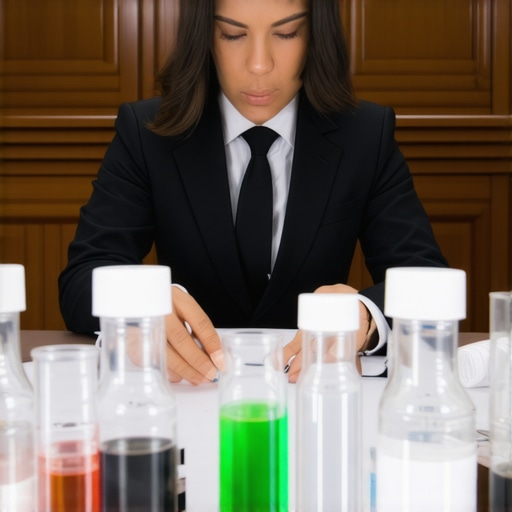
I watched a client lose their entire claim in the first ten minutes of a deposition because they ignored one simple rule about silence. They thought the facts would speak for themselves. They believed the lab report from the state was an objective truth that could not be challenged. That silence in the face of flawed data was their undoing. In the world of high-stakes criminal defense, specifically when dealing with a DUI, the state is not your friend and their equipment is not infallible. I have spent twenty-five years in the trenches of the courtroom, smelling the stale coffee of late-night evidence reviews and the ozone of high-tech forensic labs. If your lawyer does not have a key to a private laboratory, you are walking into a trap set by the prosecution. The legal system is not a search for truth; it is a battle of procedural leverage and scientific scrutiny.
The phantom alcohol in the machine
DUI defense strategies must account for the fact that breathalyzers do not measure blood alcohol directly. They measure breath and multiply by a partition ratio. A DUI attorney identifies when mouth alcohol or RFI interference triggers a false reading. Calling an attorney early ensures these technical anomalies are preserved for court and forensic review. Most people assume that when they blow into a tube, the number that flashes on the screen is a biological certainty. It is not. It is a mathematical guess based on a fixed ratio that assumes every human being has the same lung capacity and body temperature. If you have a fever, the machine will overestimate your alcohol levels. If you have acid reflux, the machine will detect stomach gases and flag them as booze. A defense firm with forensic lab access does not just look at the ticket. We look at the source code of the machine. We look at the maintenance logs. We find the drift in the infrared spectrometry sensors that the police ignored for six months because they were too busy to send the unit for service. While most lawyers tell you to plead out if the BAC is high, the strategic play is to wait for the lab’s maintenance logs, which often reveal the machine was broken for weeks before your arrest.
“Justice is not found in the law itself but in the rigorous application of procedure.” – Common Law Maxim
Why your blood sample is a ticking time bomb
DUI legal outcomes often depend on the biological stability of a blood vial stored in a police locker. Without forensic lab access, you cannot verify if the vial contained sufficient preservative or if fermentation occurred during storage. A DUI lawyer uses independent labs to retest samples and expose false positives. When the state takes your blood, they put it in a grey-top tube containing sodium fluoride and potassium oxalate. If the technician does not shake that tube exactly seven to ten times, the chemicals do not mix. If they do not mix, the blood begins to rot. As blood rots, it ferments. Fermentation produces ethanol. You could be stone-cold sober when the needle hits your arm, but three weeks later, after that vial has sat in a warm evidence room, the lab will find a 0.09. That is not the alcohol you drank; that is the alcohol the bacteria in the vial created. An independent forensic lab can test for the presence of these bacteria. They can check the levels of the preservatives. If the levels are low, the evidence is trash. A standard DUI lawyer will never see this. They see a 0.09 and tell you to take the deal. I see a 0.09 and I see a chemistry project gone wrong.
The hidden flaws in state toxicology labs
DUI defense requires a deep dive into the internal standards of government laboratories which are often understaffed and prone to cross-contamination. Independent forensic experts can audit the gas chromatography data to find peaks that indicate contamination or equipment failure. Calling an attorney who understands these technical failures is the only way to win. Government labs are factories. They process thousands of samples a month. The technicians are tired. They take shortcuts. They do not clean the injection ports on the gas chromatograph between runs. This leads to carry-over, where the high alcohol level of the previous person’s sample bleeds into yours. We have seen cases where a technician accidentally switched the labels on two vials, giving a sober grandmother the BAC of a career alcoholic. Without a private lab to perform a DNA profile on the blood in that vial, you would never know. You would just be another statistic. The state relies on your ignorance. They expect you to see the badge and the lab coat and surrender. I do not surrender. I hire a chemist who makes more money an hour than the state’s entire team to find the one mistake that ends their case.
“The fundamental requirement of due process is the opportunity to be heard at a meaningful time and in a meaningful manner.” – Mathews v. Eldridge, 424 U.S. 319 (1976)
The laboratory technician’s hidden agenda
DUI legal defense must include a background check on the analysts who handled the evidence. Many state labs have a history of dry-labbing where technicians make up results instead of running tests. A DUI attorney with forensic resources can uncover these patterns of fraud and have entire batches of evidence suppressed. It is a dirty secret in the legal world that some lab techs are more interested in their conviction rate than their accuracy. They know that if they provide a result that helps the prosecutor, they will keep their job and get promoted. We look for the raw data files. We do not want the summary report. We want the chromatograms. We want to see the baseline noise. If the baseline is jumpy, the machine was not calibrated. If the integration of the peaks is done manually instead of by the software, the tech was massaging the numbers. This is where cases are won. Not in the dramatic speeches to the jury, but in the dry, boring analysis of a calibration curve. If the r-squared value of that curve is less than 0.999, the whole batch is suspect. I have seen judges throw out three years of evidence because we proved one tech was cutting corners on their morning coffee break.
The cost of forensic silence
DUI lawyer fees are an investment in the forensic technology needed to dismantle the prosecution’s narrative. Choosing a firm without lab access is choosing to accept the state’s version of reality without a fight. Forensic evidence is the only objective shield against the subjective observations of a police officer. A cop can say you smelled like beer. They can say your eyes were red. They can say you failed the walk and turn. But all of that is subjective opinion. It is a story they tell to justify the arrest. The only thing that can refute that story is hard, cold science. If we can prove the blood test was wrong, the cop’s observations become irrelevant. If the science is broken, the arrest is illegal. But you cannot get that science for free. You cannot get it from a lawyer who works out of the back of their car and charges five hundred bucks for a plea. You need a strategist who understands the logistics of a forensic counter-attack. You need someone who knows which lab to call at three in the morning to get a private draw before the body metabolizes the evidence of your innocence.
The jury’s blind faith in decimal points
DUI defense must overcome the psychological bias that juries have toward scientific data. A skilled DUI attorney uses forensic experts to explain to the jury why a 0.08 is not a magic number but a range of possibility. Calling an attorney who can humanize the science is vital for a verdict. People love numbers. They think a 0.08 is different from a 0.079 in a way that is absolute. It is our job to show them the uncertainty of measurement. Every machine has a margin of error. In most state labs, that margin is plus or minus ten percent. That means a 0.08 could actually be a 0.072. Legally, that is the difference between a conviction and a dismissal. We use the lab to demonstrate this variability. we bring the pipettes into the courtroom. We show them how easy it is to miscalculate a dilution. We make the jury doubt the decimal point. Once they doubt the number, they have to doubt the whole case. That is the power of forensic lab access. It turns the state’s strongest weapon into their biggest liability. Don’t let a machine decide your future. Let a scientist and a trial lawyer fight back.