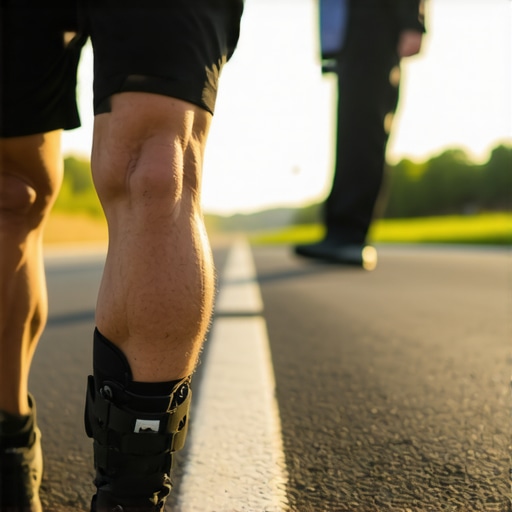
I watched a client lose their entire claim in the first ten minutes of a traffic stop because they ignored one simple rule about silence and their own medical history. The client had a documented lumbar spine fusion from 2018. When the officer asked him to step out of the vehicle on a sloped highway shoulder, the client felt compelled to prove his sobriety. He tried to balance on one leg while the wind from passing semi-trucks buffeted his frame. He wobbled. The officer did not see a man with a fused spine; the officer saw a DUI suspect failing a standardized field sobriety test. By the time he reached my office, the police report was already a work of fiction that labeled his physical disability as alcohol impairment. This is the reality of the dui defense landscape where the one-leg stand is used as a weapon against the physically compromised.
The inherent failure of the one leg stand
The One-Leg Stand (OLS) is a divided attention test that requires a DUI suspect to maintain balance while counting aloud. Police officers look for four specific clues of impairment: swaying, using arms for balance, hopping, or putting the foot down. For those with physical injuries, these clues are inevitable. When you call an attorney, the first thing we analyze is the NHTSA manual guidelines that officers frequently ignore during a roadside investigation. The manual explicitly states that people with certain physical conditions or those over age 65 may have difficulty performing this test regardless of their blood alcohol concentration (BAC). Despite this, dui legal experts see officers push injured drivers into these tests daily. The dui attorney must then deconstruct the arresting officer testimony to show the court that the test was a physiological impossibility for the defendant.
“Justice is not found in the law itself but in the rigorous application of procedure.” – Common Law Maxim
Physics versus the police officer notepad
The physics of balance dictates that any orthopedic injury to the knee, ankle, or hip will cause a DUI suspect to fail the one-leg stand. Police officers are trained to score the test based on a binary outcome: either you meet the NHTSA standards or you are impaired. This ignores the vestibular system and proprioception. A dui lawyer knows that the environment of the stop is rarely considered. A road with a two percent grade is enough to cause a sober person to sway. If you are facing dui charges, the legal strategy involves bringing in a biomechanical expert to testify that your pre-existing condition made the test invalid from the start. While most lawyers tell you to argue about the number of drinks you had, the strategic play is often to challenge the probative value of the physical evidence itself to let the prosecution’s clock run out on scientific reliability.
Invisible injuries that lead to wrongful arrests
Invisible injuries such as vertigo, inner ear infections, or old sports injuries are frequently misinterpreted by dui legal teams and law enforcement alike. A dui attorney must investigate the medical records of the client to establish a baseline of physical limitation. Many drivers suffer from neuropathy or chronic back pain that prevents them from standing still for thirty seconds, even in their own living room. When a police officer demands a one-leg stand on the side of a busy interstate, they are setting the driver up for a wrongful arrest. The dui lawyer will use this information gain to file a motion to suppress the results of the field sobriety tests. This is not about finding a legal loophole; it is about the fact that standardized tests are only reliable when the subject is physically capable of performing them.
“The integrity of the judicial process depends upon the absolute reliability of the evidence presented against the accused.” – American Bar Association Journal
The tactical error of consenting to roadside gymnastics
The tactical error of consenting to a one-leg stand is that it provides subjective evidence for the prosecution to use against you. A dui attorney will tell you that the officer’s notepad is not a scientific instrument. It is a prosecutorial tool. If you have a physical injury, you must call an attorney immediately after an arrest to ensure that body camera footage is preserved. This footage often shows the sloped ground, the windy conditions, or the uneven pavement that the officer conveniently forgot to mention in their police report. The dui lawyer uses this procedural mapping to show that the probable cause for the arrest was based on flawed data. In many jurisdictions, the one-leg stand is the weakest link in the government’s case because it relies so heavily on human balance, which is fickle and fragile even under the best conditions.