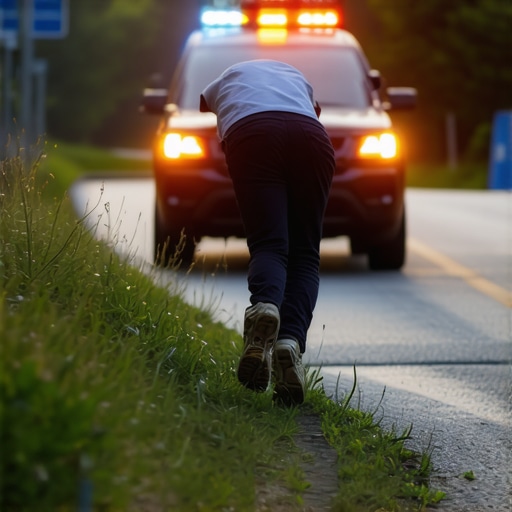
I smell like strong black coffee and the cold indifference of a courtroom at 8:00 AM. You think you failed because you were impaired, but I am here to tell you that you were doomed before you even stepped out of your vehicle. I watched a client lose their entire claim in the first ten minutes of a deposition because they ignored one simple rule about silence, yet in DUI legal circles, the silence often starts with the officer failing to mention the terrain. Most people assume the side of the road is flat. It is not. Engineering standards for highway drainage require a crown or a lateral slope to prevent hydroplaning, and that tiny angle is the difference between a clean record and a criminal conviction. When you are standing on a four-degree grade while an officer demands you balance on one leg, you are fighting physics, not the law.
The hidden angle of the shoulder
Standardized Field Sobriety Tests or SFSTs are designed by the National Highway Traffic Safety Administration to be performed on level ground. Any roadside slope, no matter how slight, invalidates the One Leg Stand and Walk and Turn tests by shifting the center of gravity. A dui defense strategy must focus on these environmental variables. Case data from the field indicates that police reports almost never document the specific grading of the asphalt. This is a deliberate omission. The human body uses the vestibular system, proprioception, and visual cues to maintain upright posture. When the ground beneath your feet is not level, your brain receives conflicting signals. On a slanted shoulder, your downhill leg bears more weight, and your uphill leg must compensate by engaging the hip flexors in a way the test was never designed to measure. This is not about your sobriety; it is about the structural engineering of the highway. If you find yourself in this position, you must call an attorney to secure the forensic surveying of that specific stretch of road before the state repaves it.
“Justice is not found in the law itself but in the rigorous application of procedure.” – Common Law Maxim
Why your balance is not the problem
Human biomechanics dictates that postural sway increases significantly when the support surface is uneven or inclined. In the context of dui attorney work, we analyze the vestibular system and how gravity affects the pivot foot during the One Leg Stand. Even a sober individual will exhibit clues of impairment on a slope. While most lawyers tell you to sue immediately, the strategic play is often the delayed demand letter or the aggressive motion to suppress evidence based on the violation of NHTSA protocols. The manual is clear: the surface must be level. It does not say mostly level or close enough. When an officer instructs you to walk a straight line on a surface designed to funnel water away at a steep angle, they are setting you up for a forensic failure. The skeletal structure of the human ankle is not meant to maintain a 90-degree lock while the body weight is shifted laterally. Any staccato movement or hop is a natural reaction to gravity, yet the officer marks it as a sign of alcohol consumption. This is why you need a dui lawyer who understands the difference between a neurological deficit and a geological one.
The forensic reality of highway drainage
Highway engineering manuals such as those from AASHTO specify that shoulders must have a cross slope to ensure water runoff. These drainage slopes typically range from two to six percent, which is more than enough to disrupt the fine motor skills required for field sobriety testing. Procedural mapping reveals that the prosecution often relies on the officer’s subjective observation rather than objective measurements of the scene. When I scrutinize a dashcam video, I am not looking at the driver; I am looking at the horizon line and the angle of the police cruiser. If the cruiser is leaning, the suspect is leaning. The physical laws of the universe do not suspend themselves because a badge is present. The Walk and Turn test requires you to keep your arms at your sides and walk heel-to-toe. On a slope, your arms naturally move away from your body to act as a counterbalance. The officer calls this a clue. I call it a survival instinct. You are being judged on your inability to override your own biology in the face of an uneven environment.
“The integrity of the evidence is the bedrock of the adversarial system, and where the foundation is flawed, the structure must fall.” – American Bar Association Journal of Trial Advocacy
How the prosecution hides the slope
District attorneys and prosecutors will attempt to minimize environmental factors by claiming the roadway was reasonably level or that the defendant did not complain at the time. A dui attorney knows that the burden of proof rests on the legality of the test administration. Most defendants are too intimidated to point out that they are standing in a drainage ditch. They try their best to comply, which is the first mistake. The second mistake is not documenting the scene. I have sent private investigators to the exact GPS coordinates of an arrest with a digital level and a plumb line. When we present the court with evidence that the road had a five-degree lateral tilt, the officer’s testimony about a slight stagger suddenly loses all its weight. The courtroom is a game of leverage. If the foundation of the evidence is cracked, the entire case can be dismantled. We look for the micro-details: the way the light hits the asphalt, the direction of the water flow marks, and the angle of the suspect’s boots relative to their shins.
The strategic move to call an attorney early
Legal representation should be secured immediately following a DUI arrest to preserve physical evidence of the arresting site. A dui lawyer will use photogrammetry and site inspections to challenge the probable cause of the arrest. Every second you wait, the evidence of the road condition degrades or is altered by weather and traffic. You do not need a sympathetic ear; you need a strategist who treats your case like a forensic autopsy. The goal is to prove that the tests were not just difficult, but scientifically invalid. We scrutinize the officer’s training records to see if they were ever actually taught how to identify a level surface. Often, they were not. They are taught to find a spot and start the clock. In the world of high-stakes litigation, that lack of precision is an opening. We exploit that opening to protect your rights and your future. Do not rely on the officer’s memory of the night. Rely on the hard, unyielding physics of the ground you were standing on.
The tactical endgame of terrain evidence
Expert testimony from accident reconstructionists or civil engineers can often be the tipping point in a DUI case. By quantifying the slope and the force of gravity acting upon the defendant, a dui defense team can provide the jury with an alternative explanation for the failed balance tests. This is the information gain that wins cases. While the state presents a narrative of intoxication, we present a narrative of environmental impossibility. It is a cold, clinical approach that removes the emotion from the courtroom and replaces it with data. The Standardized Field Sobriety Test is a tool, but like any tool, it is useless if used incorrectly. A hammer cannot drive a screw, and a balance test cannot measure sobriety on a hill. If the procedure was flawed, the result is fiction. You must hold the state to the standard they claim to uphold. If they cannot provide a level playing field, they cannot claim a fair result. Call an attorney who knows how to measure the world around you, because that is where the truth is hidden.