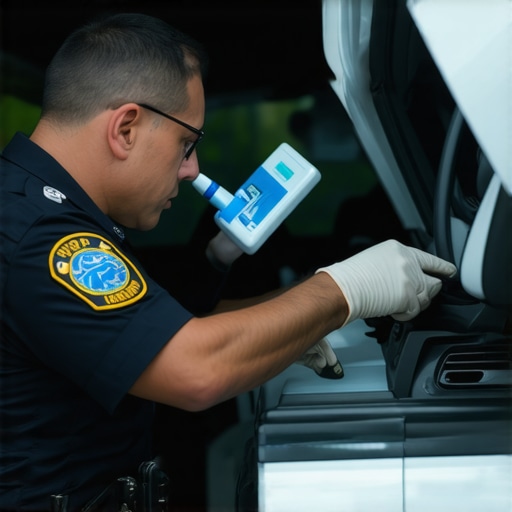
I watched a client lose their entire defense in the first ten minutes of a traffic stop because they ignored one simple rule about silence and instead chose to argue about the Fourth Amendment with a bored state trooper. They thought they were being a constitutional hero. They thought that by refusing the breathalyzer, they were starving the state of evidence. Instead, they were handing the prosecution a hammer. This client, a high-earning executive with no prior record, spent the next two years walking to work because they didn’t understand that the road is not a sanctuary of absolute rights. It is a regulated corridor where you traded your privacy for a plastic card in your wallet. If you think the law protects your refusal, you are playing a game of chess where you have already lost your queen before the first move.
The administrative trap of implied consent
Implied consent statutes mandate that any driver using public highways has already given permission for a chemical test. A dui attorney will explain that this is a civil contract between you and the state. Violating this contract results in an automatic license suspension regardless of your sobriety. When you signed that application at the DMV, you didn’t just get the right to drive; you signed a waiver. This waiver states that in exchange for the privilege of operating a motor vehicle, you agree to submit to a breath, blood, or urine test if a police officer has probable cause to suspect you of impairment. The moment you say no at the window of your car, the Department of Motor Vehicles begins a process that is entirely separate from your criminal case. You can be found not guilty of the DUI in a court of law and still lose your license for a year or more because you breached the administrative contract. This is the duality of dui defense that blindsides the arrogant.
“Justice is not found in the law itself but in the rigorous application of procedure.” – Common Law Maxim
The procedural zooming of these cases reveals a terrifying efficiency. Once a refusal is recorded, the officer completes a sworn affidavit. This document travels to the state licensing agency. Within days, a notice of suspension is mailed. You have a window, usually ten days, to request a hearing. If you miss that window, the suspension is set in stone. At this hearing, the standard of proof is not beyond a reasonable doubt; it is a preponderance of evidence. The hearing officer is often an employee of the same agency trying to pull your license. This is not a fair fight. It is a bureaucratic meat grinder. The dui legal reality is that the state does not need a conviction to take your mobility. They only need proof that you were told the consequences and said no anyway.
[IMAGE_PLACEHOLDER]
Why your contract is already broken
Dui defense starts with the realization that the officer’s body camera and the implied consent warning are the most dangerous tools for the prosecution. If the officer reads the warning correctly and you refuse, that refusal is often admissible as consciousness of guilt in your criminal trial. Imagine a jury sitting in a box. They are told that you refused to take a simple test that could have proven your innocence. To a juror, refusal looks like a confession. They don’t see a person standing up for their rights; they see a person who knew they were over the limit. A dui lawyer has to spend thousands of dollars in expert testimony to explain why a sober person might refuse, but the damage is usually done the second the video is played. The strategy of refusal is often a relic of 1980s legal advice that has no place in a modern courtroom equipped with high-definition digital evidence.
“An administrative license revocation is not a criminal penalty but a civil exercise of state police power for public safety.” – American Bar Association Traffic Court Committee
The technical anatomy of the breathalyzer itself provides another layer of risk. Devices like the Intoxilyzer 8000 use infrared spectrometry to measure ethanol molecules in the breath. These machines are sensitive to ambient temperature, radio frequency interference, and the internal body temperature of the subject. However, when you refuse, you lose the ability to challenge the machine’s calibration. You cannot argue that the machine was faulty if there is no test result to attack. You have effectively traded a technical battle, which a skilled dui attorney can win, for an evidentiary vacuum that the prosecution fills with your perceived guilt. It is a tactical error of the highest magnitude. The prosecutor will stand before the jury and ask why an innocent person would fear a machine that is scientifically validated.
The ghost in the settlement conference
Call an attorney before you make a decision that will haunt your professional life for a decade. The prosecutorial leverage gained from a refusal case is massive because it simplifies their burden. They no longer have to explain complex blood-alcohol curves or the science of absorption. They only have to show the jury that you were uncooperative. In many jurisdictions, the penalty for refusal is harsher than the penalty for a first-time high-BAC conviction. You are essentially volunteering for a worse outcome to avoid a test that might have actually been beatable. The strategy should always be about controlled data. If the machine is used, we have data to fight. If the blood is drawn, we have a sample to re-test at an independent lab. If you refuse, we have nothing but the officer’s word against yours, and in a courtroom, the badge usually carries the tie-breaker.
What the defense does not want you to ask
No-refusal warrants are the modern answer to the refusal strategy, making the entire debate moot in many counties. If you refuse, the officer simply taps a button on a tablet, sends a digital warrant application to a judge on duty, and receives a signed search warrant for your blood within minutes. You are then taken to a hospital or a station, strapped down if necessary, and your blood is taken by force. Now, you have a license suspension for the refusal AND the state has your blood evidence for the criminal charge. You have managed to get the worst of both worlds. The era of the strategic refusal is dead. It has been replaced by an era of digital warrants and aggressive forensic collection. The only way to navigate this landscape is to have a dui lawyer who understands the timing of these warrants and can find the one procedural flaw in the digital chain of custody. The law is not a shield; it is a landscape of traps, and you are currently walking through it blindfolded.
The final reckoning on legal strategy
The cold reality is that most people who refuse a breath test do so out of fear, not out of a deep-seated love for the Bill of Rights. That fear is what the prosecution feeds on. A dui legal strategy built on fear is a failing strategy. You must understand the procedural mapping of your specific jurisdiction. In some states, a refusal cannot be used against you in court, but those states are becoming a vanishing minority. In the rest of the country, your silence is a loud, clear signal to the jury that you are hiding something. Instead of refusing, the play is often to submit and then call an attorney to dismantle the process. We look for the 20-minute observation period violation. We look for the lack of a valid operator permit. We look for the failure to maintain the logbooks. We find the microscopic errors in the machine’s maintenance. These are the tools of a trial lawyer. Refusal is the tool of someone who has already given up. Don’t be the person who thinks they are winning while the handcuffs are being tightened.