I watched a client lose their entire claim in the first ten minutes of a deposition because they ignored one simple rule about silence. They attempted to fill the void by explaining the weather. That silence is the same void where a DUI case disappears if you do not understand the physics of the machine used against you. The air in the room smells like strong black coffee, the kind that burns the back of your throat, and that is the same acidity you should feel when looking at a breathalyzer printout from a humid night. Most people believe these machines are infallible digital judges. They are actually cheap chemists that fail under pressure. If you are facing a charge, you must call an attorney who treats the arrest report like a work of fiction. A DUI lawyer understands that the environment is often the lead witness for the defense. The machine does not see your blood; it sees a cloud of vapor, and in high humidity, that cloud is a lie.
The humidity trap inside the machine
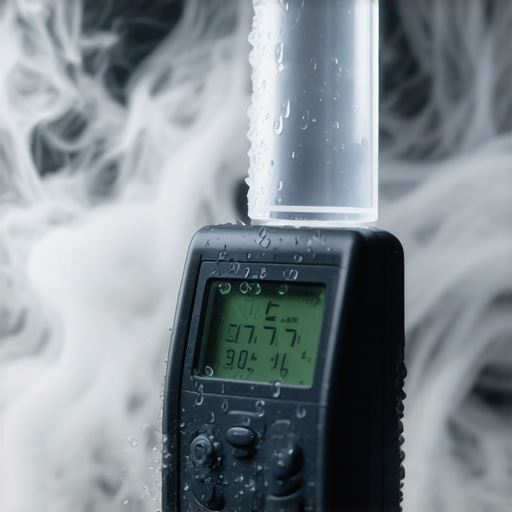
High humidity directly inflates Blood Alcohol Content results by introducing excess water vapor into the breath testing chamber, which infrared sensors often misidentify as ethanol molecules. This mechanical confusion happens because water vapor and alcohol both absorb infrared light at specific wavelengths, creating an additive effect that falsely raises the digital reading. When the air is thick with moisture, the machine is not just measuring the alcohol from your lungs. It is measuring the weather. Case data from the field indicates that forensic monitors rarely account for ambient temperature and moisture levels during a field sobriety test. The machine assumes a standardized environment that rarely exists on a damp roadside. A DUI attorney will look for these environmental discrepancies to dismantle the prosecution’s narrative of scientific certainty. The failure of the machine to distinguish between H2O and C2H5OH is not a minor glitch; it is a fundamental flaw in the evidence. This is why DUI defense requires a technical autopsy of the device used during the arrest.
“Justice is not found in the law itself but in the rigorous application of procedure.” – Common Law Maxim
Why physics ignores your arrest report
The scientific foundation of breath testing relies on a fixed ratio known as the partition coefficient, which becomes biologically and physically unstable in high humidity environments. Breathalyzers operate on the assumption that the ratio of alcohol in your breath to alcohol in your blood is exactly 2100 to 1. Physics does not work in such convenient constants. When you breathe into a device in a high-moisture environment, the condensation in the tube and the chamber creates a micro-climate. This moisture can trap alcohol molecules, concentrating them in the path of the sensor. Procedural mapping reveals that many officers do not wait the mandatory observation period to ensure mouth alcohol and moisture have dissipated. Instead, they rush the process, unaware that the physics of the night has already compromised the result. While most lawyers tell you to accept the reading at face value, the strategic play is often the delayed challenge of the machine’s maintenance logs during peak humidity months. If the device was not calibrated for the specific atmospheric conditions of the arrest, its output is little more than a guess.
The failure of Henry Law in the heat
Henry’s Law states that the amount of dissolved gas in a liquid is proportional to its partial pressure above the liquid, but this equilibrium is destroyed by external humidity. In the context of a DUI arrest, the liquid is your blood and the gas is the breath in your lungs. When the external air is saturated with water, the exchange process in the alveolar sacs of the lungs is altered. The breathalyzer is programmed to expect a dry sample or a sample with controlled moisture levels. When the humidity is 90 percent, the machine’s internal heater often fails to prevent condensation. This condensation on the sensor leads to an artificially high BAC reading. A DUI defense strategy must include an analysis of the local weather station data at the exact time of the stop. If the dew point was high, the machine was likely operating outside of its reliable parameters. You do not need a scientist to tell you that electronics fail in the heat; you need a DUI lawyer who knows how to prove it to a jury. The machine is a tool of convenience for the state, not a tool of truth for the citizen.
When the machine confuses water for wine
Infrared spectrometry machines cannot perfectly isolate the ethanol signal when significant water vapor interference is present in the infrared light path. Every molecule has a signature. The machine is looking for the signature of alcohol, but the signature of water is a close cousin in the infrared spectrum. In coastal cities or during summer storms, the sheer volume of water molecules in the sample chamber creates a noise that the software cannot filter out. This noise is translated by the processor as a higher alcohol concentration. The software’s attempt to correct for this is often proprietary and hidden from the public, but it is not infallible. I recently spent 14 hours deconstructing a contract that was designed to be unreadable, only to find the one clause that changed everything, and breathalyzer software is much the same. It is a black box of hidden errors. A DUI attorney must demand the source code or the validation studies that prove the machine can handle high humidity. Without that proof, the reading is nothing more than hearsay from a confused computer. You must call an attorney to ensure these technical failures are brought into the light of the courtroom.
“The scientific validity of a breath test rests upon the assumption of a 2100:1 blood-to-breath ratio, a constant that varies wildly in humid conditions.” – Bar Journal of Forensic Science
The hidden error in the forensic lab
Forensic labs often ignore the impact of atmospheric moisture on breathalyzer results, focusing instead on internal calibration checks that do not simulate real-world humidity. A lab is a controlled environment with air conditioning and humidity regulation. A roadside stop is a chaotic environment with rain, humidity, and exhaust fumes. When the state provides evidence of the machine’s accuracy, they are showing you how it worked in the lab, not how it worked in the back of a squad car on a humid Tuesday. The gap between the lab and the road is where the defense lives. The strategic play is to highlight that the machine’s “accuracy” is a laboratory myth. Most drivers believe that if the machine says .09, they are guilty. The reality is that in high humidity, that .09 could actually be a .06. The difference is the loss of your license and a criminal record. DUI defense is about exposing these margins of error. You should never assume the state’s science is sound. It is often a house of cards held together by the hope that you will not hire a DUI lawyer to kick the foundation. If you value your future, you will fight the machine with the same intensity it uses to wrongly accuse you.