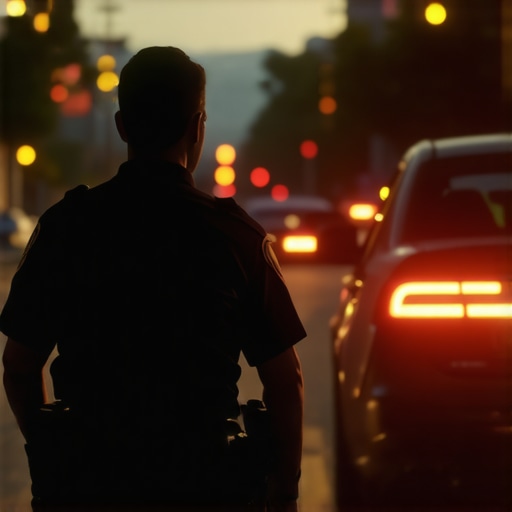
I smell strong black coffee and the metallic scent of a police cruiser idling at midnight. You are sitting in the driver’s seat. Your heart is hammering against your ribs. The officer is walking toward your window with a flashlight that feels like a spotlight in a stage play where you forgot your lines. I have seen this scenario thousands of times in twenty-five years of trial work. Most people think they can talk their way out of a DUI. They believe that being a nice person or a pillar of the community will earn them a pass. I am here to tell you that is a lie. The moment those red and blue lights flashed, the officer stopped being a public servant and became a forensic data collector for the prosecution. Your job is not to be liked. Your job is to survive the encounter without handing the state the evidence they need to ruin your life. I watched a client lose their entire claim in the first ten minutes of a stop because they ignored one simple rule about silence. They thought they were being helpful by explaining they only had two glasses of wine with dinner. That admission alone destroyed their defense before I even saw the police report.
The silence that saves your license
DUI legal protections begin the moment you are pulled over. You must provide your license, registration, and proof of insurance, but you are not required to answer questions about your destination, your activities, or your consumption of alcohol. Invoking your right to remain silent is a tactical necessity. When an officer asks where you are coming from, they are not making small talk. They are looking for the ‘odor of intoxicants’ and slurred speech. Case data from the field indicates that drivers who volunteer information are prosecuted at a significantly higher rate than those who remain politely silent. The officer will try to use silence as a psychological weapon, making you feel like a criminal for exercising a constitutional right. Do not fall for it. Tell the officer that you are exercising your right to remain silent and that you wish to speak with a DUI attorney. This is not about being difficult. This is about procedural leverage. While most lawyers tell you to sue immediately or beg for mercy, the strategic play is often the delayed response to let the officer’s initial adrenaline cool while you maintain your composure. A DUI defense is built on the gaps in the officer’s narrative, and those gaps are created by your refusal to fill them with your own words.
The mechanical failure of the walk and turn
DUI defense strategies often hinge on the fact that field sobriety tests are designed for failure. These tests are subjective assessments disguised as scientific evaluations. You have the right to refuse these roadside gymnastics in almost every jurisdiction without immediate criminal penalty. The National Highway Traffic Safety Administration (NHTSA) has strict protocols for the Horizontal Gaze Nystagmus (HGN), the Walk and Turn, and the One Leg Stand. If the officer’s pen is not exactly twelve to fifteen inches from your nose, the HGN test is legally compromised. If the ground is not perfectly level, the Walk and Turn is a farce. I have seen trials won because the officer forgot to ask if the defendant had any inner ear issues or leg injuries before demanding they balance on one foot. These tests are not about your balance; they are about your ability to follow complex, multi-part instructions under extreme stress. Every stumble or missed heel-to-toe connection is a data point for the prosecution. Procedural mapping reveals that juries often find these tests less credible when the defense can show the officer failed to follow the manual to the letter. Don’t give them the data. Politely decline the tests. It is better to deal with the suspicion of a refusal than the certainty of a failed test on a dashcam video.
“Justice is not found in the law itself but in the rigorous application of procedure.” – Common Law Maxim
The tactical error of the voluntary breathalyzer
DUI lawyer tactics distinguish between the portable breath test at the scene and the evidentiary breath test at the station. Refusing the roadside breathalyzer often carries fewer consequences than refusing the official test at the precinct. You must understand this distinction to protect your record. The little handheld devices used at the curb are notoriously unreliable. They are sensitive to mouth alcohol, recent tobacco use, and even ambient temperature. They are used to establish probable cause for an arrest, not as final evidence in court. If you blow into that device, you are giving the officer the green light to put you in handcuffs. Information gain from years of litigation shows that the strategic play is to force the officer to make a decision based on their observations alone rather than a digital number that may be calibrated incorrectly. Once you are at the station, the rules change due to implied consent laws. At that point, a refusal might mean an automatic license suspension. However, a seasoned DUI defense will tell you that a suspension is often a small price to pay compared to a criminal conviction supported by a high blood alcohol reading. You are playing a game of risk management, and the goal is to minimize the total damage to your future.
What the defense doesn’t want you to ask
Call an attorney as soon as you are permitted to do so because the window for preserving evidence is incredibly small. The prosecution will not tell you that the dashcam footage might be overwritten in thirty days or that the breathalyzer’s maintenance logs are public record. You need to know if the officer who stopped you has a history of disciplinary issues or a pattern of making illegal stops. You need to know if the specific machine used to test your breath has been flagged for errors in the past. The skeletal reality of a DUI case is that it is a battle of paperwork and procedure. If the officer lacked reasonable suspicion to pull you over in the first place, the entire case might be thrown out on a motion to suppress. This is the ‘bleed’ of litigation that the state wants to avoid. They want a quick plea deal that keeps their conviction rates high. They do not want a trial lawyer who will spend twelve hours deconstructing the three minutes of footage from the stop. Your defense starts with your conduct at the window, but it is won in the microscopic analysis of the officer’s every move. Every second you spend talking is a second you are not thinking about your strategy.
“The right of the people to be secure in their persons, houses, papers, and effects, against unreasonable searches and seizures, shall not be violated.” – U.S. Constitution, Fourth Amendment
The ghost in the settlement conference
DUI legal experts know that the real story of a case is often found in what is not in the police report. Officers often omit the fact that the weather was poor or that the lighting was insufficient for a proper field sobriety test. When you are sitting in a conference room with a prosecutor, you are not just a name on a file. You are a set of variables. If you remained silent, refused the voluntary tests, and demanded a lawyer, you are a high-risk variable for the state. They would much rather offer a reduced charge to someone who made their job difficult than spend the resources fighting a well-prepared defense. It is not about the truth of whether you had a drink; it is about the perception of whether they can prove it beyond a reasonable doubt in a courtroom. You must be the skeptical investor of your own freedom, calculating the ROI of every word you speak. The courtroom is territory, and you have already lost ground if you tried to be the officer’s friend. Stick to the protocol, stay silent, and let the machinery of the law work for you instead of against you. The outcome of your case was decided the moment the officer touched your window. If you followed the rules of the litigation architect, you have a fighting chance. If you talked, you have a long road ahead of you.