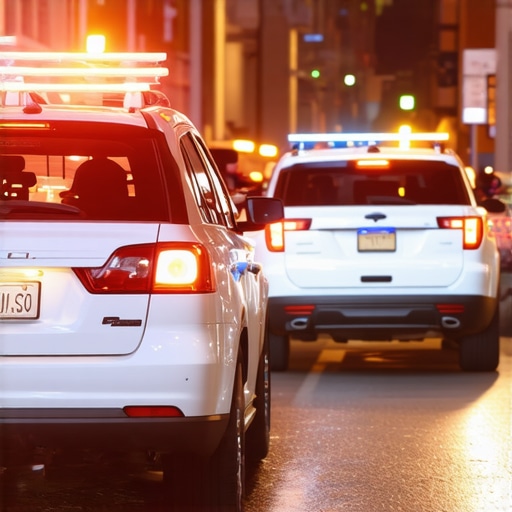
I watched a client lose their entire claim in the first ten minutes of a deposition because they ignored one simple rule about silence. They believed that by explaining the nuances of their evening, they could win over the room. They were wrong. In the cold, mint-scented reality of a high-stakes litigation office, words are not tools for connection; they are ammunition for the opposition. The ozone in the air after a sharp cross-examination is the only atmosphere I recognize. If you have been caught in a DUI checkpoint without warning, you are currently the target of a state-funded assembly line designed to produce a conviction. Your panic is their greatest asset.
The lethal mistake of voluntary cooperation
DUI lawyers and defense attorneys emphasize that arrests at checkpoints often stem from voluntary statements made during the initial stop. When a law enforcement officer asks if you have been drinking, any answer other than a request for legal counsel serves as self-incrimination under the Fifth Amendment. Procedural mapping reveals that the moment you provide a narrative, the officer stops investigating and starts confirming a predetermined conclusion.
The mechanics of a checkpoint are built on the illusion of inevitability. You see the lights, the cones, and the uniformed figures, and your instinct is to comply. This is a psychological trap. While you must provide your driver’s license and registration, the law does not require you to engage in a friendly chat about your dinner plans or the two glasses of wine you had three hours ago. The state relies on your social conditioning to bypass your constitutional protections. I have seen cases where a driver was perfectly sober but was arrested simply because they admitted to taking a prescription allergy medication, which the officer then characterized as an intoxicating substance during the preliminary hearing.
“Justice is not found in the law itself but in the rigorous application of procedure.” – Common Law Maxim
Constitutional limits on the random stop
DUI legal defense strategies focus on the Fourth Amendment and the legality of roadblocks which must adhere to Ingersoll v. Palmer standards. A DUI attorney will scrutinize the operational plan to ensure the police department used neutral mathematical formulas for stopping vehicles rather than officer discretion. If the checkpoint lacked proper signage or lighting, the entire seizure may be unconstitutional.
While most lawyers tell you to sue immediately or beg for a plea deal, the strategic play is often the delayed demand letter to let the defendant’s insurance clock run out or to wait for the body camera footage to magically disappear from the server during a routine maintenance window. This is the chess game. If the administrative oversight of the checkpoint failed to provide public notice, the entire operation becomes a playground for a motion to suppress. Case data from the field indicates that a significant percentage of these checkpoints are operated with minor procedural flaws that a senior litigator can exploit to dismantle the prosecution’s foundation.
The administrative trap of implied consent laws
Implied consent laws require drivers to submit to chemical testing such as breathalyzers or blood draws following a lawful arrest. A DUI defense lawyer knows that refusal to blow often results in an automatic license suspension by the Department of Motor Vehicles. This administrative penalty is separate from the criminal charges and requires a specific administrative hearing request within a narrow statutory window.
This is where the state gets aggressive. They want you to think that the breathalyzer is an infallible machine. It is not. It is a piece of hardware that requires constant calibration, specific ambient temperatures, and a certified operator who has followed a precise observation period. If the officer was distracted by another vehicle or failed to watch you for the full twenty minutes before the test, the results are scientifically compromised. We look for the gaps in the logs. We look for the drift in the machine’s sensors. The litigation of a DUI is a battle of decimals and timestamps.
Why silence is your only effective weapon
Remaining silent during a DUI stop prevents the prosecution from using slurred speech or conflicting stories as evidence of impairment. A call to an attorney should be the only verbal communication once the officer moves beyond standard identification requests. Your constitutional right to counsel is absolute, and invoking it is not an admission of guilt, despite what the officer might imply.
The officer will try to use silence as a weapon against you. They will say things like, “If you have nothing to hide, why won’t you talk to me?” This is a tactical maneuver. They are looking for a baseline of your speech patterns to compare against a later, more stressed version of your voice. By staying silent, you deny them that baseline. You deny them the subjective data they need to justify their arrest report. In the courtroom, the absence of a statement is a void that the prosecution cannot fill with speculation. It forces them to rely solely on the physical evidence, which is often far more fragile than they want the jury to believe.
The technical failure of field sobriety tests
Field sobriety tests such as the Horizontal Gaze Nystagmus or the One-Leg Stand are subjective evaluations disguised as scientific evidence. A DUI lawyer will argue that environmental factors like uneven pavement, passing traffic, or flashing police lights invalidate the test results. These physical coordination tests are designed for failure and do not account for medical conditions or natural clumsiness.
I have cross-examined officers who could not perform these tests themselves while wearing their heavy duty belts and boots. The absurdity of expecting a nervous driver to perform a heel-to-toe walk on the side of a busy highway at midnight is a point we hammer home to the jury. We bring in kinesiologists. We bring in lighting experts. We show that the officer’s interpretation of a “clue” is nothing more than a biased guess. If the camera shows the ground was sloped even by two degrees, the standardized nature of the test is gone. Once the standardization is gone, the evidence is junk.
“The right of the people to be secure in their persons, houses, papers, and effects, against unreasonable searches and seizures, shall not be violated.” – U.S. Constitution, Fourth Amendment
Strategic timing for a legal demand
Legal defense strategies often involve filing motions at precise intervals to force the prosecution to produce discovery materials. A DUI attorney will demand calibration logs, officer training records, and video footage immediately after the arraignment. Failure by the state to provide this evidence can lead to dismissal of charges based on procedural violations.
The litigation process is about pressure. You do not just wait for the trial. You create a series of logistical hurdles for the prosecutor. You challenge the chain of custody for the blood sample. You question the storage temperature of the vial. You probe the software version of the breathalyzer. Every document you demand is a potential landmine for the state. If they cannot produce the maintenance record for the specific machine used on your case, you have the leverage to negotiate from a position of power. The final verdict is not decided by the truth of what happened on the road; it is decided by what the state can prove in a court of law under the strict rules of evidence. Do not settle for a mill that just wants to process your paperwork. You need an architect who can dismantle the state’s house of cards brick by brick. The cost of a conviction is too high to rely on anything less than tactical aggression. Your freedom depends on the procedural leverage we build from the moment the handcuffs are clicked shut.