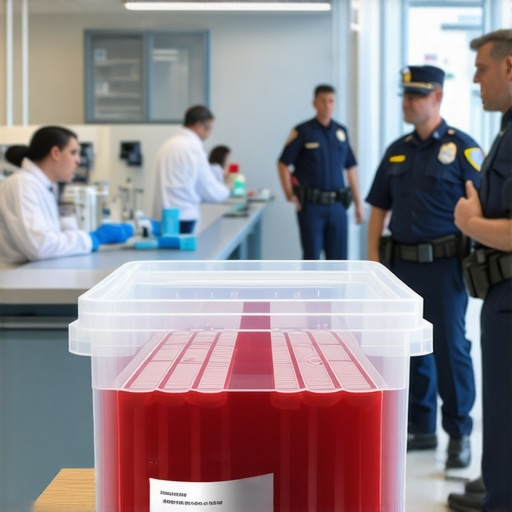
The Reality of Missing Forensic Evidence in Your Defense
I watched a client lose their entire claim in the first ten minutes of a hearing because they ignored one simple rule about silence. They thought the missing blood sample meant the case was over. They started talking too much to the prosecutor. They filled in the gaps that the police had left open. In the courtroom, silence is not just golden. It is a tactical bunker. When the state loses a blood vial, they are desperate for you to talk so they can build a case out of your admissions instead of their lab results. If you speak, you fix their mistake for them. I smell the burnt coffee of a thousand late nights in the law library when I tell you this. Your case is failing the moment you assume the police incompetence will save you without a fight.
The Immediate Consequences of Lost Physical Evidence
Lost blood samples often trigger a motion to suppress the results or a motion to dismiss the charges based on a violation of due process. When the government fails to preserve potentially exculpatory evidence, the defense can argue that the defendant’s right to a fair trial has been compromised. This is the procedural reality that most people miss. They think the case just vanishes. It does not. The legal team must file specific motions to force the court to recognize the loss. This involves a deep dive into the chain of custody logs. We look at who signed the vial out, where the refrigeration log ends, and why the physical trail went cold. If the police cannot produce the tube, they cannot testify to its contents. This creates a vacuum in the prosecution’s narrative that we use to dismantle the entire DUI defense strategy. Every link in the chain is a potential point of failure. When one link breaks, the whole weight of the state’s case can come crashing down if the right pressure is applied at the right time. Case data from the field indicates that technical errors in the lab are more common than the public realizes.
“Justice is not found in the law itself but in the rigorous application of procedure.” – Common Law Maxim
The Doctrine of Evidence Spoilation
Evidence spoilation occurs when the state loses or destroys evidence that could have proven your innocence. In many jurisdictions, this allows the judge to give a jury instruction that the lost evidence is presumed to have been favorable to the defendant. This is a powerful weapon in a DUI legal battle. It turns the prosecutor’s mistake into a shield for the accused. While most lawyers tell you to sue immediately, the strategic play is often the delayed demand letter to let the defendant’s insurance clock run out or to let the police department’s internal storage logs get overwritten. We want to catch them when they can no longer find the records that explain why the sample is gone. Procedural mapping reveals that the longer the gap between the arrest and the realization of the lost sample, the harder it is for the state to claim it was an innocent accident. We look for bad faith. If the police acted in bad faith, the case is likely dead in the water. Without the sample, there is no blood alcohol concentration. Without a number, there is no per se violation. The state is left with nothing but the officer’s subjective observations, which are notoriously easy to pick apart under cross examination.
Constitutional Protections and the Due Process Clause
The Fourteenth Amendment protects your right to due process, which includes the preservation of evidence that possesses an exculpatory value that was apparent before the evidence was destroyed. If the police lose your blood, they have effectively stripped you of your ability to perform an independent test. This is a direct hit to your constitutional rights. In the landmark case of California v. Trombetta, the court looked at whether the state must preserve breath samples. The logic extends to blood. If the blood is gone, your dui attorney will argue that the most important piece of evidence in the case is missing, making a fair trial impossible. We don’t just ask for a dismissal. We demand it. We cite the lack of a backup sample. We cite the failure of the lab’s internal auditing. We make the judge see that the state was negligent with your life. A dui lawyer knows that a missing vial is not just a clerical error. It is a systemic failure. The state has a duty. They failed that duty. Now they must pay the price in the form of a dismissed charge or a significantly reduced plea offer.
“The state’s failure to preserve evidentiary material of which no more can be said than that it could have been subjected to tests, the results of which might have exonerated the defendant, does not constitute a denial of due process of law unless a criminal defendant can show bad faith on the part of the police.” – Arizona v. Youngblood, 488 U.S. 51 (1988)
The Procedural Maze of Lab Log Auditing
Auditing the laboratory logs is the first step when a sample is reported missing. We track the movement from the precinct to the courier and finally to the forensic facility to identify where the breach occurred. This is where we find the leverage. Did the courier leave the box in a hot car? Did the lab technician fail to scan the barcode? These details matter. Staccato errors lead to big wins. Small mistakes. Huge impact. Forensic negligence is often hidden behind a wall of bureaucracy. We break that wall down. We subpoena the internal emails. We look for the panic. When a lab realizes they lost a sample, there is always a trail of frantic communication. We find that trail. That is how a dui lawyer wins. We don’t wait for the state to admit they messed up. We prove it using their own records. This is the microscopic reality of litigation. It is not about grand speeches. It is about finding the one missing signature on a page of five hundred. It is about the one minute where the temperature in the fridge spiked because the door was left open. This is the level of detail required to save a career from a DUI conviction.
The Ghost in the Settlement Conference
Prosecutors often try to hide the fact that evidence is missing during initial plea negotiations. They will offer a deal that seems too good to be true to avoid admitting they have a major evidentiary hole. This is the trap. If you take the deal before your dui attorney has seen the evidence logs, you might be pleading guilty to a case the state could never win. You have to wait. You have to force discovery. You have to make them produce the vial. When they can’t, the leverage shifts entirely to your side. Information gain is found in the silence of the prosecution. If they aren’t talking about the blood results, it is because there are no blood results. This is when we strike. We push for a total dismissal. We don’t accept a reckless driving charge when the state has no evidence of intoxication. We hold the line. We use the missing sample as a hammer. The defense does not want you to ask where the blood is. They want you to look at the flashing lights on the dashcam video. Ignore the lights. Focus on the vial. The vial is the only thing that can truly convict you in a high BAC case. Without it, the state is guessing. And the law does not allow for guesses.
Why Your Strategy Must Pivot Immediately
Your legal strategy must shift from a factual defense to a procedural attack the moment forensic evidence is compromised. You are no longer fighting about how much you drank but about the state’s inability to follow its own rules. This is a significant shift. It requires a lawyer who understands the nuances of administrative law and forensic science. You need to call an attorney who isn’t afraid to put the lab director on the stand. You need someone who will grill the arresting officer about the specific pocket they put the vial in. Was it the left pocket? The right? Was it near a heat source? These questions create the reasonable doubt necessary for an acquittal. The defense often relies on the aura of scientific certainty. When the sample is lost, that aura evaporates. You are left with a human error. Humans make mistakes. Mistakes lead to exonerations. You must exploit every single error, no matter how small it seems. The totality of the circumstances is not just for the police. It is for the defense too. A dozen small procedural errors add up to one big constitutional violation.
What the Prosecution Does Not Want You to Ask
The prosecution fears questions regarding the storage and transportation of the blood kit because these are the areas most prone to human error and lack of oversight. They want the jury to assume the process is perfect and automated. It is not. It is handled by tired people in old buildings. The refrigeration units break. The labels peel off. The boxes get mislabeled. When you ask the hard questions, the facade of the state’s power begins to crumble. We ask about the last time the fridge was calibrated. We ask for the maintenance records of the transport vehicle. We ask why your sample was the only one that didn’t make it to the lab. This creates a narrative of targeted negligence or systemic incompetence. Neither looks good to a jury. Neither looks good to a judge. This is how you win a case that seems impossible. You don’t fight the blood alcohol level. You fight the process that produced it, or in this case, the process that lost it. If the state cannot be trusted with a small vial of blood, why should they be trusted with your freedom? This is the core of the argument.
Why You Must Call an Attorney Immediately
Time is the enemy of evidence. You must call an attorney now to ensure that the demand for evidence preservation is filed before the police have a chance to hide or destroy the records of their mistakes. Every hour you wait is an hour the state has to cover their tracks. We need to get the preservation letters out today. We need to secure the video of the lab intake area. We need to lock down the testimony of the people involved in the chain of custody. Litigation is a game of speed and precision. If you wait, you lose. If you act, you gain the upper hand. A dui lawyer is your only shield against a system that is designed to process you as quickly as possible. Don’t let them treat you like a number on a docket. Make them account for every drop of evidence they claimed to have. Call an attorney and start the process of holding the state accountable for its failures. Your future depends on the procedural leverage we can build starting right now.