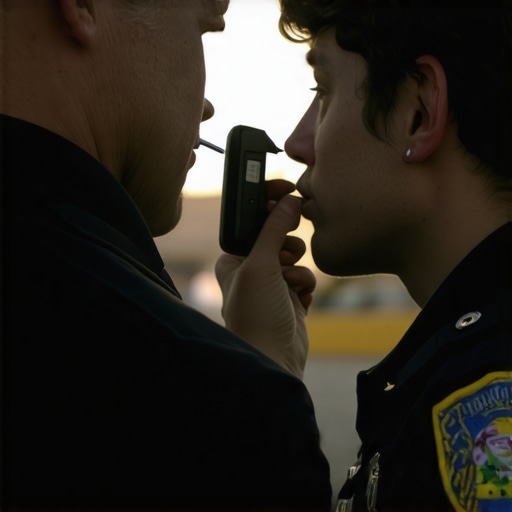
Mouth Alcohol Spikes and the Illusion of Breathalyzer Accuracy
I recently spent 14 hours deconstructing the administrative code governing breath testing in this jurisdiction, only to find the one clause regarding mouth alcohol that changed everything for my client. The legal system wants you to believe that a breathalyzer is a portable laboratory. It is not. It is a fallible machine that uses light absorption to guess the amount of ethanol in your system. I have seen cases where a simple dental bridge or a case of indigestion turned a legal driver into a criminal on paper. I smell like strong black coffee and I am here to tell you that your case is likely failing right now because you trust the machine more than the science of physiology.
The fundamental failure of infrared spectrometry
Infrared spectrometry identifies ethanol by measuring the absorption of light at specific wavelengths within a breath chamber. However, mouth alcohol creates a spike in the breath sample that the Intoxilyzer cannot distinguish from alveolar air, leading to a falsely high BAC during a DUI arrest.
The machine operates on the principle of Henry’s Law. This law assumes a fixed partition ratio of 2100 to 1 between the alcohol in your blood and the alcohol in your breath. If you have raw ethanol sitting in your mouth from a recent drink, a burp, or trapped behind a crown, that ratio is destroyed. The machine sees a concentrated cloud of alcohol and multiplies it by 2100. The result is a number that has no basis in biological reality. A 0.02 reading can jump to a 0.15 in seconds if a microscopic amount of liquid alcohol is present in the oral cavity. This is not a guess; it is a mathematical certainty of the hardware’s limitation.
“Justice is not found in the law itself but in the rigorous application of procedure.” – Common Law Maxim
Why the twenty minute observation period is a lie
The twenty minute observation period is the mandatory protocol where a police officer must ensure the subject does not regurgitate, belch, or consume anything. If this deprivation period is violated, the breath test results are scientifically invalid and should be suppressed by a dui lawyer.
In practice, officers rarely stare at a suspect for twenty minutes. They fill out paperwork. They check their phones. They talk to colleagues. Any silent burp brings stomach gases into the mouth. These gases contain raw alcohol that has not yet been processed by the liver. When the subject blows into the tube, the machine captures this “mouth alcohol” and reports it as blood alcohol. The prosecution will tell the jury that the machine has a slope detector to catch this. They are wrong. The slope detector is a software algorithm that looks for a specific curve in the breath flow. If the mouth alcohol is mixed evenly with the breath, the slope detector remains silent. It is a failing safety net that gives a false sense of security to the court.
How acid reflux creates a false positive
Gastroesophageal Reflux Disease or GERD causes stomach acid and alcohol vapors to rise into the esophagus and mouth. This physiological condition creates a constant source of mouth alcohol that makes breathalyzer results completely unreliable for dui defense purposes in a court of law.
If you suffer from chronic heartburn, your breath test is a legal landmine. The machine is calibrated to read air from the deep lungs, known as alveolar air. It assumes this air has reached an equilibrium with the blood. When you have GERD, you are effectively blowing stomach vapors into the sensor. The concentration of alcohol in the stomach is significantly higher than in the blood. Even a small amount of reflux can inflate a breath test result by 300 percent. Most officers do not ask about medical history before the test. They want the number. They want the arrest. A seasoned dui attorney knows that medical records are more important than the police report in these scenarios.
Why your dental work is a legal liability
Dental work such as crowns, bridges, and dentures can trap food particles and liquid alcohol in periodontal pockets. This trapped ethanol leaches into the breath sample, causing a mouth alcohol spike that a dui lawyer can use to challenge the prosecution case.
I have seen instances where a suspect had not had a drink in three hours, yet they blew over the limit. The culprit was a hollow bridge that held a few drops of wine. Every time the person exhaled forcefully into the machine, the pressure change pulled those vapors out. The machine, in its mechanical ignorance, calculated a BAC that would indicate the person was nearly unconscious. Procedural mapping reveals that these physical anomalies are often ignored because the state wants to maintain the myth of the “gold standard” breath test. It is your responsibility to call an attorney who understands that a bridge is not just dental work; it is a potential source of contaminated evidence.
“The integrity of the forensic process hinges on the strict adherence to scientific protocols during evidence collection.” – American Bar Association Standards
The scientific myth of the slope detector
The slope detector is a software function designed to identify the rapid rise and fall of alcohol concentration associated with mouth alcohol. When the algorithm fails, the breathalyzer accepts the contaminated sample, necessitating dui legal intervention to protect the defendant from false evidence.
If the mouth alcohol is present at the beginning of the breath, the slope might be detected. But if it is introduced halfway through the exhalation, the machine often fails to flag it. The software is dated. Many of these machines use processing power equivalent to a calculator from the 1990s. They are not sophisticated enough to handle the complex dynamics of human breath. The state relies on the fact that juries are intimidated by digital displays. They see a number and they think it is the truth. The brutal truth is that the number is the result of a flawed calculation based on a contaminated sample. Case data from the field indicates that a significant percentage of “failing” tests are actually technical errors disguised as evidence.
What the defense doesn’t want you to ask
Discovery motions must target the source code and maintenance logs of the breathalyzer unit. By examining the internal error codes, a dui attorney can demonstrate that the machine was malfunctioning or sensitive to radio frequency interference at the time of arrest.
While most lawyers tell you to sue immediately, the strategic play is often the delayed demand letter to let the defendant’s insurance clock run out or to wait for the machine’s next calibration cycle to see if it failed. If the machine was taken out of service shortly after your test, that is a red flag. If the officer’s training certificate has expired, that is a red flag. Every detail matters. The courtroom is a territory of logistics. If the state cannot prove the machine was working perfectly and that the 20 minute rule was followed to the second, the evidence is a house of cards. Do not walk into a plea deal without an expert autopsy of the machine’s history. Your case is failing because you are playing their game by their rules. It is time to change the rules. Call an attorney who knows how to break the machine’s credibility.