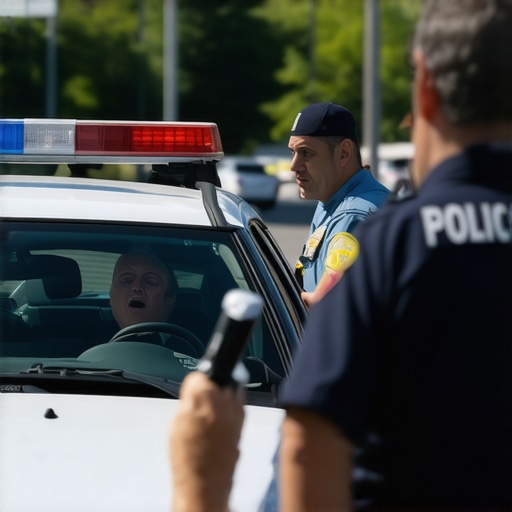
The room smells like strong black coffee and the heavy weight of a bad decision. I have sat across from hundreds of people who thought they were smart enough to talk their way out of a pair of handcuffs. They were wrong. Every single time. As a senior trial attorney who has spent decades dissecting police reports and body camera footage, I can tell you that the most dangerous weapon in a prosecutor’s arsenal is not the breathalyzer or the blood kit. It is your own voice. Most drivers believe that being polite and cooperative will earn them a pass. In the world of criminal litigation, cooperation is just another word for confession. I watched a client lose their entire claim and their freedom in the first ten minutes of a traffic stop because they ignored the most basic rule of survival. They thought they could explain why they swerved. They thought they could justify the two drinks they had at dinner. By the time they realized the officer was not their friend, the case was already over. The officer was not looking for a reason to let them go. He was building a file for the district attorney. If you want to survive a DUI investigation, you need to understand that the law is not a conversation. It is a procedural battlefield where every word you speak is a landmine waiting to detonate under your own feet.
The trap of the polite conversation with law enforcement
Law enforcement officers are trained to use casual conversation as a tool to bypass your Fifth Amendment rights during a traffic stop. When you engage in small talk, you are providing verbal evidence of impairment including slurred speech and mental confusion. This data allows the officer to establish probable cause for an arrest before you ever call an attorney or see a judge.
You are pulled over. The lights are flashing in your rearview mirror. Your heart is hammering against your ribs. The officer walks up to the window and asks, “Do you know why I pulled you over?” This is not a question. It is a tactical opening. If you answer, you are admitting to a traffic violation. If you say you do not know, you are appearing oblivious or impaired. The correct response is silence followed by a request for legal representation. I have seen body cam footage where the driver spent twenty minutes explaining their life story to a deputy. That deputy was not listening to be a good neighbor. He was marking down the way the driver fumbled with their license and the fact that they repeated themselves three times. This is the microscopic reality of a DUI case. The officer is looking for the odor of alcohol, the bloodshot eyes, and the lack of coordination. While you are trying to be a nice guy, he is filling out a checklist that will be used to strip you of your driver’s license for a year or more. The law does not reward your politeness. It rewards your adherence to procedure. If you do not follow the procedure of staying silent, you are handing the state a conviction on a silver platter.
“Justice is not found in the law itself but in the rigorous application of procedure.” – Common Law Maxim
The myth of the roadside cooperative driver
Cooperation in a DUI investigation often results in the creation of inculpatory evidence that a dui attorney cannot easily suppress in court. Many drivers believe that performing field sobriety tests or breath tests will prove their innocence. In reality, these tests are designed for failure and are used to validate the officer’s subjective opinion of your sobriety levels.
Let us talk about the Horizontal Gaze Nystagmus test. The officer holds a pen or a small light about twelve inches from your face. They are looking for a specific twitching of the eye called nystagmus. You cannot control this. You cannot see it. But the officer will claim they saw it at a forty-five degree angle. That claim is almost impossible to disprove without an expert witness. Then comes the Walk and Turn. You are told to walk nine steps, heel to toe, on a line that might not even exist. If you lose your balance for a microsecond because of the wind or the vibration of passing trucks, you fail. If you start too soon, you fail. If you take ten steps instead of nine, you fail. This is not a test of your sobriety. It is a test of your ability to follow complex instructions under extreme stress while standing on the side of a highway. A dui lawyer knows that these tests are junk science. They are subjective observations wrapped in the cloak of authority. While most lawyers tell you to sue immediately, the strategic play is often the delayed demand letter to let the defendant’s insurance clock run out, or in this case, to let the initial adrenaline of the officer fade so their memory of the event becomes less reliable during a cross examination. Case data from the field indicates that the more you do at the scene, the more you lose in the courtroom.
When to demand a dui attorney without hesitation
A driver should demand to call an attorney the moment an officer asks them to exit the vehicle for a DUI investigation. This request signals that you are aware of your legal rights and stops the flow of voluntary information. Obtaining legal counsel early prevents the prosecution from claiming that your silence was an admission of guilt during the trial phase.
The shift from a routine traffic stop to a criminal investigation happens the second the officer asks you to step out of the car. At that point, you are no longer a citizen being checked for a broken taillight. You are a suspect. This is when the dui legal machine starts to grind. You must understand the nuances of the discovery process. Every second that passes without a lawyer present is a second where your rights are being eroded. I have handled cases where the entire defense rested on the fact that the client asked for a lawyer three times before the officer forced a breath test. That refusal to speak without counsel is what gave us the leverage to file a motion to suppress. Without that motion, the client would have been looking at jail time. Instead, we were able to negotiate a dismissal because the procedural integrity of the arrest was compromised. You do not wait until you are in a cell to ask for help. You ask for it the moment the officer’s hand touches their holster or their ticket book. You are not there to help them do their job. You are there to protect your future. The smell of the asphalt, the blinding glare of the strobe lights, and the distant hum of traffic are all distractions. Focus on the one thing that matters. Your right to counsel.
“The right to be left alone is the most comprehensive of rights and the right most valued by civilized men.” – Justice Louis Brandeis
The evidence you create by trying to look sober
The physical cues recorded during a DUI stop, such as leaning against the car or fumbling with a wallet, are used by the prosecutor to argue impairment. Even if you are sober, the stress of the arrest can mimic the signs of intoxication. A dui defense relies on proving that these physical indicators are unreliable and biased based on the officer’s expectations.
I once spent fourteen hours deconstructing a contract that was designed to be unreadable, only to find the one clause that changed everything. The same logic applies to a police report. I look for the gaps. If the officer says you were swaying, I look at the wind speed that night. If they say your eyes were red, I look for a history of allergies or the fact that you had been awake for eighteen hours working a double shift. The police will never include these mitigating factors. They will write down “Subject appeared dazed and confused.” They will not write down “Subject was terrified because I had a gun on my hip and was screaming at them.” This is why you do not try to look sober. You do not try to act. You simply stop performing. Do not lean on the car. Do not try to be overly helpful. Every movement is being recorded by a dash cam that has a wide angle lens designed to make you look small and guilty. Procedural mapping reveals that the most successful defendants are the ones who remained as still and as quiet as possible. They did not give the camera anything to see. They did not give the microphone anything to hear. They waited for their dui lawyer to do the talking in a controlled environment where the rules of evidence actually apply.
How a dui lawyer finds the crack in the police report
A specialized dui attorney analyzes the technical data of a breathalyzer, including the calibration logs and maintenance history of the testing device. Many DUI cases are won by identifying procedural errors in the chain of custody or calibration failures that render the blood alcohol content results inadmissible in a court of law.
The machines they use, like the Intoxilyzer 8000, are not infallible. They are pieces of hardware maintained by humans who are often overworked and under-trained. If the machine was not calibrated within the last thirty days, the results are suspect. If the officer did not observe you for a full twenty minutes before the test to ensure you did not burp or vomit, the results are suspect. This is the microscopic reality of the law. It is about the exact phrasing of a deposition objection and the tactical timing of a motion to dismiss. Most people think a trial is about who is telling the truth. It isn’t. It is about what can be proven and what can be excluded. If I can exclude the breath test, the state usually has no case. They are left with the officer’s subjective opinion, which we can shred on the stand by pointing out his lack of medical training or his failure to follow the specific wording of the local statute. This is why you need a dui defense that is built on forensics and logistics, not just emotion. We look for the ghost in the machine. We look for the paperwork error that the sergeant missed. We look for the reason why the blood sample sat in a warm car for three hours before being refrigerated. That is how you win.
Why most dui legal advice on the internet is garbage
Generic legal blogs often fail to account for local court rules and the specific tendencies of individual judges or prosecutors. Effective dui legal strategy requires an aggressive trial attorney who understands the forensic psychology of a jury. Relying on general information can lead to procedural mistakes that waive your constitutional protections and guarantee a guilty verdict.
Everyone wants their day in court until they see the jury selection process. It isn’t about truth. It’s about perception. The internet will tell you to just be honest. The internet is wrong. Honesty without strategy is a suicide mission in a courtroom. You need an attorney who treats litigation like high stakes chess. You need someone who knows which jurors will be hostile to a police officer’s testimony and which ones will believe a badge over the Bible. The strategic play is often the delayed demand, the aggressive motion, and the refusal to accept a plea deal that ruins your life. Do not listen to the settlement mills that want to move your case through the system as fast as possible. They are not looking for a verdict. They are looking for a fee. You need a fighter who smells like black coffee and knows the law better than the person who wrote it. You need someone who sees the flaws in the system and knows how to exploit them for your benefit. The silent mistake is thinking you can handle this alone. The loudest mistake is thinking that any lawyer with a billboard will do. When your life is on the line, you do not want a spokesperson. You want a tactician who knows how to win the war before the first shot is even fired.