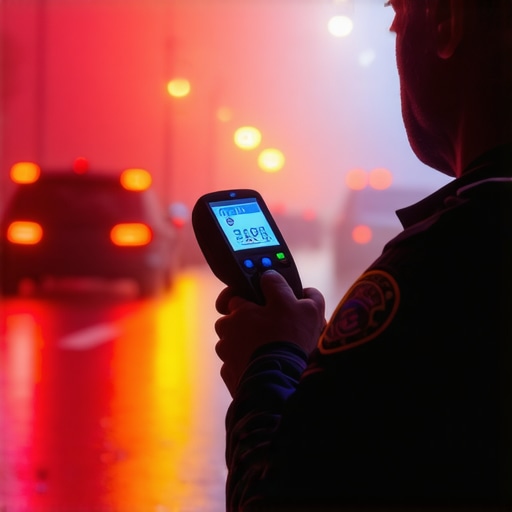
The tactical reality of the roadside breath test refusal
I watched a client lose their entire claim in the first ten minutes of a deposition because they ignored one simple rule about silence. It was a cold Tuesday morning, and the air in the conference room was heavy with the smell of stale coffee and industrial cleaner. The client thought he could explain why the machine was wrong. He thought he could win the officer over with logic. By the time he finished speaking, he had admitted to three drinks and a ‘slight’ feeling of lightheadedness. He handed the prosecution the conviction on a silver platter. In the world of high-stakes DUI defense, your greatest enemy is not the law; it is your own impulse to fill the silence. Litigation is a game of evidence preservation, and the roadside is the first battlefield where most defendants surrender before the fight even begins.
The silence that saves your license
Refusing a roadside breath test is a strategic decision designed to limit the prosecution’s evidence. While a refusal often triggers an administrative license suspension under implied consent laws, it prevents the state from obtaining a specific Blood Alcohol Content (BAC) measurement that is notoriously difficult to challenge in a criminal trial later. Case data from the field indicates that a missing chemical test forces the state to rely on subjective officer observations. These observations are vulnerable to cross-examination. The machine is a black box. Without a number, the jury has to rely on the officer’s memory, which is often flawed. A DUI lawyer knows that a refusal shift the burden of proof back where it belongs: on the government’s ability to prove impairment through observation rather than flawed math.
The biological fraud of the partition ratio
The machines used by law enforcement, such as the Intoxilyzer 8000, rely on a mathematical assumption known as the partition ratio. They assume that for every 2,100 milliliters of breath, there is a corresponding amount of alcohol in the blood. This 2100:1 ratio is a scientific average, not a biological constant. Your body is not a calculator. If you have a high body temperature, a specific lung capacity, or a high hematocrit level, the machine will overestimate your BAC. Procedural mapping reveals that these machines are often calibrated using a standard that ignores individual physiology. When you blow into that tube, you are betting your freedom on an average that might not apply to you. A DUI attorney will tell you that the machine is looking for a reason to fail you, not a reason to clear you. The infrared spectrometry used in these devices can be confused by acetone, which is common in people on low-carb diets or those with diabetes. This is not science; it is a search for a number that fits a predetermined narrative.
“Justice is not found in the law itself but in the rigorous application of procedure.” – Common Law Maxim
Why the machine at the station is a liar
The evidentiary breath test performed at the police station is subject to strict maintenance protocols that are frequently ignored or poorly documented. If the officer fails to observe the defendant for a full twenty minutes prior to the test, the results are scientifically invalid due to the risk of mouth alcohol contamination. Forensic psychology suggests that officers, under pressure to close cases, often cut corners during this observation period. They might be filling out paperwork or checking their phones while you are supposed to be under their direct gaze. If you burp, hiccup, or regurgitate even a microscopic amount of stomach acid during that window, the machine will register a spiked reading. This is the ‘bleed’ of the legal process. A DUI legal expert will demand the maintenance logs, the dry gas standard records, and the internal diagnostic checks. Often, these logs reveal a machine that has been failing its own self-tests for weeks. Suing immediately or filing a motion to suppress based on these technical failures is the only way to stop the state’s momentum.
The tactical timing of a motion to suppress
Success in the courtroom is about logistics. A motion to suppress is a flank attack on the state’s evidence. If we can prove the initial stop lacked reasonable suspicion, or the arrest lacked probable cause, every piece of evidence gathered afterward, including a breath test result, becomes fruit of the poisoned tree. This is where the ex-military strategist mindset pays off. We are not just arguing; we are denying the enemy the terrain they need to stand on. While most lawyers tell you to sue immediately, the strategic play is often the delayed demand letter or a specific motion to exclude the test based on the officer’s failure to follow the manufacturer’s manual. We zoom in on the exact phrasing of the implied consent warning. Did the officer read it correctly? Did they threaten you with consequences that are not supported by the statute? These are the microscopic details that win cases.
The math of a tactical refusal
Refusing the roadside test changes the ROI of your litigation by forcing the prosecutor to spend more resources for a lower probability of conviction. Without a BAC reading, the state’s case is a house of cards built on the officer’s subjective interpretation of your performance on field sobriety tests. Case data from the field indicates that many prosecutors are more willing to offer a reduced charge, such as reckless driving, when they lack a chemical smoking gun. This is a cold, clinical calculation. The ‘bleed’ for the state is the time and money required to bring an officer and a toxicologist to court to testify about ‘general impairment.’ When the state has to work for a conviction, they become more amenable to a deal. Calling an attorney as soon as the cuffs are on ensures that this tactical advantage is not squandered by an ill-advised confession in the back of the patrol car.
“The Fourth Amendment does not prohibit the warrantless search of a person’s breath incident to a lawful arrest for drunk driving.” – Birchfield v. North Dakota, 579 U.S. 438 (2016)
What the patrol officer hides from the camera
The body camera footage is a curated version of reality. The officer will testify that you had bloodshot eyes and slurred speech, but they rarely mention the wind, the passing traffic, or the blinding strobe lights from the patrol car that would make any sober person appear disoriented. These field sobriety tests are designed for failure. The ‘one-leg stand’ and the ‘walk and turn’ are divided-attention tasks that many people cannot perform under ideal conditions, let alone on the side of a highway at midnight. A DUI defense strategy involves deconstructing the ‘clues’ the officer claims to have seen. We look for the Horizontal Gaze Nystagmus (HGN) test errors. Did the officer hold the stimulus too close to your eyes? Did they move it too fast? If the protocol is not followed to the letter, the results are legally worthless. We do not accept the officer’s narrative; we rewrite it using the forensic evidence they overlooked.
The discovery phase and the missing data
The discovery process in a DUI case is where the state’s case usually begins to rot from the inside out. We demand the raw data from the breathalyzer, not just the printed receipt, because the internal software often logs errors that do not appear on the final printout. Procedural mapping reveals that software glitches in these devices are more common than the manufacturers admit. There are instances where the source code of the machine itself has been challenged in court because it was fundamentally flawed. If the state cannot produce the records showing the machine was calibrated with a fresh gas canister, the test result should be suppressed. This is the granular reality of the law. It is not about the spirit of the rule; it is about the letter of the procedure. If the state misses a deadline or loses a piece of evidence, we move for dismissal. We do not ask for mercy; we demand compliance with the law.
A hard truth about jury perception
Juries often view a refusal with a degree of skepticism, but a trial attorney uses that skepticism as a weapon against the state. We explain to the jury that the refusal was not an admission of guilt, but a refusal to participate in a rigged game. We frame the choice as a fundamental exercise of constitutional rights. Without a scientific number like .08 or .15, the prosecution is forced to rely on subjective observations which are much easier to dismantle through cross-examination. We show the jury that the ‘scientific’ test the state wanted the defendant to take is actually a flawed device with a history of errors. When the jury understands that the machine is not an oracle of truth, the refusal becomes a reasonable act of self-protection. This shift in perception is the difference between a guilty verdict and a walk-out acquittal.
The strategic delay in the demand letter
Most defendants are in a rush to end their case, but time is often the defense’s best friend. A delayed demand letter can let the defendant’s insurance clock run or allow for the fading of an officer’s memory. As witnesses become less available and evidence gets misplaced, the state’s position weakens. A DUI attorney knows that the longer a case drags on, the more likely the prosecution is to suffer from ‘litigation fatigue.’ We look for the ROI in every motion we file. If a motion to suppress the stop is successful, the case is over. If it is not, we have at least gained a preview of the officer’s testimony and identified the weaknesses in their story. We are looking for the ‘real story’ behind the police report, the story that the dashboard camera didn’t capture and the officer didn’t write down.
The ghost in the settlement conference
There is a phantom that sits in every settlement conference: the risk of trial. If a prosecutor knows you are represented by a DUI legal team that is ready and willing to take a case to verdict, their valuation of the case changes. Settlement mills will take whatever deal is offered because they are afraid of the courtroom. We are not. We view the courtroom as territory to be seized. If the state wants a conviction, they will have to fight for every inch of it. We use the discovery material, the maintenance logs, and the officer’s own errors to create a narrative of incompetence and overreach. By the time we reach the settlement conference, the prosecutor should be worried about their own win-loss record. That is how you get a case dismissed or reduced. It is not about being nice; it is about being the most expensive and difficult opponent they will face all year.
Why your contract with the state is already broken
When you signed up for a driver’s license, you entered into a contract of ‘implied consent.’ But that contract is not a blank check for the state to violate your rights. If the state fails to maintain the equipment or follow the law, they have breached their side of the agreement. A DUI attorney is there to hold them accountable for that breach. We look at the exact timing of the arrest and the chemical test. If the test was taken too late, the results do not reflect your BAC at the time of driving. This is the ‘retrograde extrapolation’ problem. The state tries to guess what your BAC was two hours earlier based on a single data point. It is junk science, and we treat it as such. We bring in our own experts to show that your BAC could have been rising or falling, making the state’s number irrelevant to the legal standard of impairment.
The final tactical assessment
Navigating a DUI charge requires a cold, clinical approach to evidence. The decision to refuse a roadside breath test is the first move in a long-term strategy to protect your future. It is about denying the state the easy win. It is about forcing the system to prove its case without the help of a flawed machine. When you call an attorney, you are not just hiring a lawyer; you are hiring a strategist who understands the forensic psychology of the courtroom and the technical failures of the law. We do not look for the ‘vibrant’ path to justice; we look for the procedural errors that lead to an acquittal. The law is a tool, and in the hands of a senior trial attorney, it is a weapon. Do not provide the evidence that will be used against you. Keep your mouth shut, refuse the roadside math, and let the professionals handle the litigation.