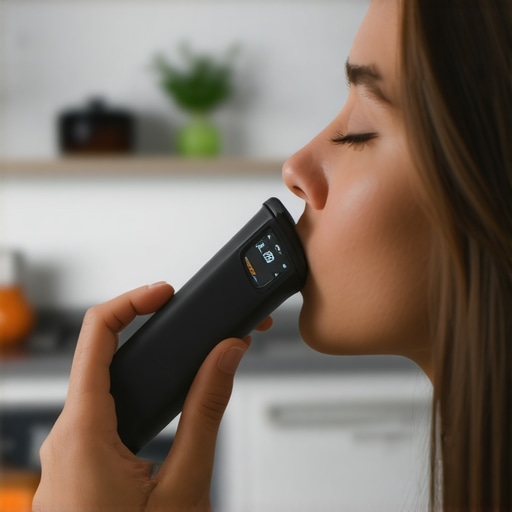
I watched a client lose their dignity in the first ten minutes of a traffic stop because they ignored the biological reality of their diet. They were on day twenty of a strict ketogenic protocol, having avoided carbohydrates with religious fervor. They had not touched a drop of alcohol in weeks. Yet, when the officer held the Intoxilyzer 8000 to their face, the machine registered a blood alcohol concentration of 0.09. The client tried to explain the biology of fat metabolism. The officer laughed while tightening the handcuffs. This is the brutal reality of the American legal system. It values the calibration of a cheap infrared sensor over the chemical truth of your blood. If you are practicing a low-carb lifestyle, you are walking around with a biological time bomb that any dui attorney will tell you can explode at the first sight of a blue light.
The chemistry of the ketosis trap
Ketosis produces isopropyl alcohol as a metabolic byproduct when the body breaks down fat for fuel instead of glucose. Most breath testing machines used by police are unable to distinguish between ethyl alcohol (from beverages) and isopropanol (from your liver). This chemical mimicry leads to false positive dui arrests for innocent drivers. When the body enters a state of nutritional ketosis, it generates three types of ketone bodies: acetoacetate, beta-hydroxybutyrate, and acetone. Acetone is volatile. It is excreted through the lungs. In a confined space like a breathalyzer chamber, this acetone can be misidentified as ethanol. A dui lawyer knows that the infrared spectroscopy used in these devices is not a gold standard of science but a shortcut for state revenue. The machine looks for specific light absorption at 3.4 and 9.4 microns. Unfortunately, the molecular structure of ketones overlaps with these frequencies. The machine sees a molecule with a hydroxyl group and assumes it is the beer you never drank. This is not a theory. It is a documented flaw in the hardware of modern law enforcement. Your dui defense depends entirely on your lawyer’s ability to explain this metabolic glitch to a jury that has been conditioned to believe the machine is infallible. Most people think a breath test is like a DNA test. It is not. It is more like a mood ring that occasionally gets lucky. If you are stopped, the smell of your breath alone, which often takes on a fruity or metallic odor during ketosis, will be used by the officer as probable cause. They will claim they smelled the ‘odor of an alcoholic beverage’ when they actually smelled the odor of your burning fat cells. This is the first lie in the police report. It will not be the last.
Breathalyzers are not scientific instruments
Breathalyzers are screening tools disguised as forensic evidence to simplify the job of the prosecutor. They rely on the Henry’s Law principle, which assumes a fixed ratio of alcohol in the breath to alcohol in the blood. This ratio is a statistical myth that ignores individual metabolic rates and lung capacity. The state wants you to believe the Intoxilyzer is a high-tech laboratory. In reality, it is a box of plastic and wires that uses 1970s light technology to guess what is in your lungs. The 2100 to 1 partition ratio used by these machines is an average. Humans are not averages. Some people have a ratio of 1500 to 1. Others have 3000 to 1. If you fall on the wrong side of the bell curve, the machine will over-report your BAC by as much as 40 percent. Add a low-carb diet to this inherent inaccuracy and you have a recipe for a wrongful conviction.
“Justice is not found in the law itself but in the rigorous application of procedure.” – Common Law Maxim
Every dui legal expert understands that the machine has a ‘slope detector’ designed to find mouth alcohol. This detector is frequently defeated by the high concentration of ketones in a keto-adapted individual. The machine thinks it is seeing a steady stream of deep lung air when it is actually seeing a concentrated cloud of metabolic waste. The state does not care about your diet. The state cares about the 0.08 number. If that number appears on the printout, the burden of proof effectively shifts to you to prove your innocence. This is a violation of the spirit of the law, but it is the reality of the courtroom.
[IMAGE_PLACEHOLDER]
What the officer ignores at the roadside
Roadside sobriety tests are subjective evaluations designed to produce failure regardless of your physical condition. Officers are trained to look for clues of impairment that are often actually physical symptoms of electrolyte imbalances common in low-carb dieters. If you are in deep ketosis, you might experience ‘keto flu.’ This includes dizziness, fatigue, and brain fog. To an officer, this looks like intoxication. They will ask you to stand on one leg. They will ask you to walk a straight line. If you sway because your sodium levels are low, they will mark it as a ‘hit’ against you. They will not ask if you have had a potato in the last month. They will only ask how many drinks you had. The correct answer is always zero, but even that will not save you if the machine is calibrated to hate your metabolism. The dui attorney you hire must be aggressive in challenging the officer’s observations. Did the officer check for the smell of ketones? Did the officer follow the mandatory 20-minute observation period? If the officer allowed you to burp or hiccup during that window, the test is invalid. These are the procedural levers that win cases. A trial is a game of millimeters. We look at the logs. We look at the maintenance records of the machine. We look at the ‘dry gas’ calibration checks. If the machine was off by even 0.005 during its last check, we have a way in. We are not just looking for truth. We are looking for the technicality that sets you free.
The myth of the partition ratio
Human physiology varies far too much for a single mathematical constant to accurately determine blood alcohol levels from a breath sample. The partition ratio assumes that for every part of alcohol in your breath, there are 2,100 parts in your blood. This assumes your body temperature is exactly 98.6 degrees. If you have a slight fever from the keto flu, the machine will report a higher BAC. If you have a high hematocrit level, the machine will report a higher BAC. The state uses this 2100 to 1 ratio because it is convenient for the prosecution. It is not science. It is a legal fiction. Your dui lawyer must be prepared to bring in a toxicologist to explain that your 0.09 was actually a 0.05 when corrected for your specific biology and your ketogenic state. We call this the ‘garbage in, garbage out’ defense. If the input data (your breath) is contaminated by ketones, the output (the BAC) is legal garbage. We challenge the search warrant. We challenge the implied consent. We make the state prove that their machine can tell the difference between a martini and a ribeye steak. Most of the time, they cannot. They rely on the fact that most people will just plead guilty out of fear. Do not be that person. The legal system is a machine that grinds up the unprepared. You need a strategist who can dismantle the machine piece by piece.
How to challenge the machine in court
A successful defense requires a deep dive into the source code and the infrared absorption peaks of the specific device used in your arrest. We do not just accept the printout as fact. We demand the full diagnostic logs. We look for ‘interference detected’ messages that the officer might have ignored. Many times, the machine knows something is wrong but the operator pushes through anyway. In a dui defense, we also look at the ‘mouth alcohol’ factor. If you have GERD or acid reflux, which can be triggered by certain high-fat diets, the acid in your stomach can bring raw alcohol or ketones up into your esophagus. This creates a massive spike in the breath test reading. The officer is supposed to wait twenty minutes to ensure your mouth is clear. If they were rushing to get back to their shift, they likely cut corners.
“The right of the people to be secure in their persons, houses, papers, and effects, against unreasonable searches and seizures, shall not be violated.” – Fourth Amendment of the US Constitution
We use the Fourth Amendment as a shield. Was the stop legal? Was the exit from the vehicle justified? Was the administration of the breath test compliant with state administrative codes? In many jurisdictions, if the machine was not calibrated within a specific window of time, the results are inadmissible. We find those windows. We find the errors in the logs. We find the reason the jury should doubt the machine. If there is doubt, there is no conviction. That is the goal. We are not trying to prove you are a saint. We are trying to prove the state is incompetent.
The specific cost of a low-carb defense
Litigating a metabolic dui is more expensive and complex than a standard case because it requires expert witness testimony and forensic blood analysis. You cannot rely on a public defender to understand the intricacies of isopropanol versus ethanol. You need a dui attorney who has a network of doctors and chemists. You will need a metabolic panel. You will need to document your diet leading up to the arrest. This is a war of attrition. The state has unlimited resources, but they have limited time. They want easy wins. When they see a defense team that is ready to litigate the molecular weight of ketones, they often start looking for a way to settle. We do not settle unless it is on our terms. A ‘reckless driving’ plea might be better than a DUI, but an outright dismissal is the only thing we truly value. You are paying for the expertise to tell the prosecutor why their star witness (the machine) is a liar. This is the ROI of high-stakes litigation. If you lose your license, you lose your job. If you lose your job, you lose your house. The cost of a proper defense is high, but the cost of a conviction is permanent. We look at the ‘bleed’ of the case. How much is the state willing to spend to defend a faulty machine? We make that cost as high as possible.
Why your lawyer needs to understand metabolism
Legal strategy must include a comprehensive understanding of endogenous ethanol production and how the body handles macronutrients under stress. If your lawyer does not know what a ketone is, they cannot defend you. They will tell you to take the deal. They will tell you the machine does not lie. Those lawyers are the ‘settlement mills’ I mentioned. They are why the system is broken. A real dui lawyer understands that the law is a living organism. It changes with the science. We stay on the cutting edge of forensic toxicology. We know the difference between the Intoxilyzer 5000 and the 8000. We know why the 9000 is even more prone to certain errors. We use this knowledge to create a narrative of technical failure. We tell the jury a story of a hardworking person who was punished for trying to be healthy. We make the officer look like a bureaucrat who is more interested in quotas than the truth. This is how cases are won. It is not about the law. It is about the perception of the law. If we can show the jury that the machine is just a box of parts that can be fooled by a salad, the state’s case collapses. Never trust a machine. Never trust a prosecutor. Only trust the data and the strategy. If you find yourself in the back of a patrol car because of your diet, call an attorney immediately. Do not talk. Do not explain. Let the lawyer handle the science. Your silence is your strongest weapon until the trial begins.