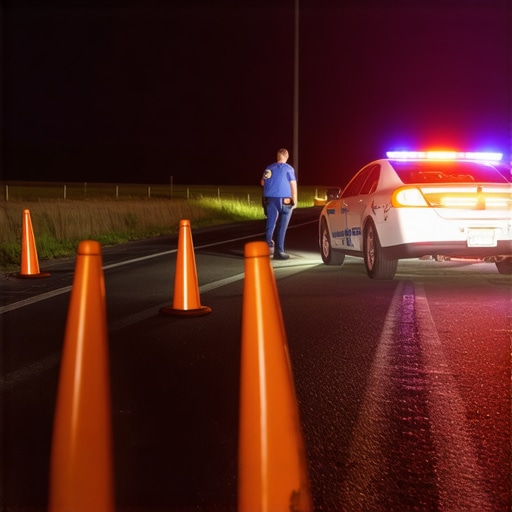
I smell like strong black coffee and I am here to tell you that your case is likely failing because you believe the justice system is a search for the truth. It is not. It is a search for procedural compliance. I watched a client lose their entire claim in the first ten minutes of a deposition because they ignored one simple rule about silence. They thought that by being helpful and explaining their three beers, they were showing the officer they were responsible. Instead, they were handing the prosecution a confession on a silver platter. In the world of high stakes litigation, your honesty is often your greatest liability. Small town sobriety checkpoints are not the impenetrable walls of justice that local police departments want you to believe they are. They are often chaotic, poorly planned, and legally fragile operations that depend on your ignorance of the law to succeed. If you are facing a charge, you need to understand that the battle is won in the technicalities of the stop, not in the morality of your choices.
The illusion of the perfect roadblock
DUI defense strategies often hinge on the fact that small town sobriety checkpoints are rarely the impenetrable walls of justice they appear to be. A dui attorney looks for technical failures in the site selection and the specific operational plan required by state law before the first car is stopped. The police cannot simply decide to set up a roadblock on a whim because they feel like catching drunk drivers on a Friday night. There must be a written plan approved by a high ranking official. This plan must dictate exactly how the cars are to be stopped, whether it is every car, every third car, or every fifth car. The moment an officer deviates from this mathematical sequence because they see a car that looks suspicious, the checkpoint becomes an unconstitutional seizure. I have seen cases dismissed because an officer got bored and started stopping every vehicle instead of following the one in three rule established in the written orders. This is the microscopic reality of the law that most people never see.
“Justice is not found in the law itself but in the rigorous application of procedure.” – Common Law Maxim
Where the training manual meets the gravel
DUI legal challenges frequently arise from the gap between the official checkpoint manual and the actual behavior of officers on a dark county road. When you call an attorney, they will immediately request the site selection criteria to see if the location was chosen for safety or revenue. The National Highway Traffic Safety Administration has clear guidelines on how these sites should be managed. There must be adequate lighting, plenty of warning signs, and a safe area for the vehicles to pull over. In small towns, these requirements are often treated as suggestions. I have defended clients who were stopped in areas so dark the officer could not even see the color of their eyes, yet the officer claimed they saw signs of impairment. The physical environment of the checkpoint is a piece of evidence. If the pavement is uneven, the results of a walk and turn test are scientifically worthless. If the wind is blowing at twenty miles per hour, the results of a breath test are compromised. We map these physical variables to dismantle the prosecution’s narrative of a controlled and fair environment.
The mathematics of a flawed breathalyzer
A dui lawyer knows that a breathalyzer is not a truth machine but a fallible chemical sensor prone to environmental interference. If the ambient temperature was not recorded or the officer failed to observe the twenty minute deprivation period, the entire scientific basis for the arrest evaporates into thin air. These machines are sophisticated, but they are only as good as the technician who maintains them. Every breath testing device has a log. That log tracks every error code, every calibration check, and every breath sample ever taken. I have spent fourteen hours deconstructing a single maintenance log to find one specific error code that proved the machine was sensing mouth alcohol rather than deep lung air. The prosecution will tell the jury that the machine is foolproof. My job is to show the jury that the machine is a box of sensitive electronics sitting in the back of a humid patrol car that hasn’t been serviced in six months. Case data from the field indicates that a significant percentage of breath results are inflated by residual alcohol in the mouth or even certain medical conditions like acid reflux.
Why your silence is a tactical necessity
A dui defense professional will tell you that the most damaging evidence is often your own voice recorded on a body camera. If you call an attorney early, they can prevent the prosecution from using your polite cooperation as an admission of guilt during the pre-arrest screening phase. The police are trained to use leading questions. They want you to admit to drinking. They want you to explain why your eyes are red. They want you to apologize. Every word you speak is a data point for their report. I tell my clients that the only words out of their mouth should be a request for a lawyer. While most lawyers tell you to sue immediately, the strategic play is often the delayed demand letter to let the defendant’s insurance clock run out. This same patient approach applies to your initial contact with the police. You are not going to talk your way out of a pair of handcuffs. You are only going to talk your way into a conviction. The silence you maintain at the checkpoint is the shield your lawyer will use in the courtroom months later.
“The Fourth Amendment is not a mere formality but a substantial protection against arbitrary government intrusion.” – ABA Journal of Criminal Justice
The paperwork trail that destroys a prosecution
DUI legal victories are won in the file folders of the local police department, not just in front of a jury. A skilled dui lawyer examines the officer’s certification records and the maintenance logs of the specific vehicle used to transport the suspect to identify fatal gaps in the chain of custody. Did the officer have their certification updated? Was the mobile breath unit calibrated within the last thirty days? Was the public notice of the checkpoint actually published in the local newspaper as required by law? These are the questions that make prosecutors uncomfortable. In small towns, the administrative side of policing often falls behind the operational side. They have the guns and the badges, but they don’t always have the filing cabinets in order. Procedural mapping reveals that when the paperwork is flawed, the arrest is flawed. We don’t look for the truth of whether you had a drink. We look for the truth of whether the government followed the rules they are sworn to uphold. If they cannot prove the machine was working or the officer was trained, they cannot prove you were guilty under the law.
How the site selection process fails
DUI defense attorneys focus on site selection because checkpoints must be established at locations with a high incidence of alcohol related accidents. If a dui lawyer discovers the police chose a spot purely for high traffic volume or convenience, the entire operation may be deemed an unconstitutional seizure of motorists. This is a common flaw in small town operations where the goal is often to meet a quota rather than to increase public safety. They set up near a popular bar or a festival without having the historical data to back up the choice. This is an arbitrary use of power. We look at the accident reports for the last five years for that specific stretch of road. If there are no alcohol related incidents on record, the checkpoint has no legal basis for existing at that location. This is the kind of forensic detail that separates a real litigator from a settlement mill. We fight the very existence of the checkpoint before we even talk about the breath test results.
The sensory reality of the field sobriety test
A dui attorney understands that the field sobriety tests are designed for you to fail. They are divided attention tasks that are difficult for a sober person to perform under the stress of flashing lights and passing traffic. When you are standing on the side of a highway with cars zooming by at sixty miles per hour, your balance is naturally compromised. The horizontal gaze nystagmus test, where the officer follows your eyes with a penlight, is even more subjective. If the officer moves the light too fast or holds it at the wrong angle, the test is invalid. Most officers in small departments have not been properly recertified in these techniques in years. They are going through the motions. We hire experts to review the body camera footage and point out every single time the officer deviated from the NHTSA manual. If the officer says you missed a step, but the video shows the pavement was cracked and sloping, we have a defense. This isn’t about whether you were impaired. It is about whether the test was fair. Usually, it isn’t.
The hidden cost of the administrative license suspension
DUI legal proceedings are actually two separate battles. One is in criminal court and the other is with the Department of Motor Vehicles. Many people make the mistake of focusing only on the jail time and forgetting about their driving privileges. In many states, you only have ten days to request a hearing to save your license. If you miss that window, you are walking for a year regardless of what happens in your criminal case. This is where the ROI of litigation becomes clear. A dui lawyer knows how to navigate the administrative hearing to cross examine the officer early. This is a free deposition. We get the officer on the record before the prosecutor has a chance to coach them. We find out where the holes are in their story. We find out if they actually remembered to read the implied consent warning. If they didn’t, the suspension can be overturned. This is the strategic leverage that wins cases in the long run.