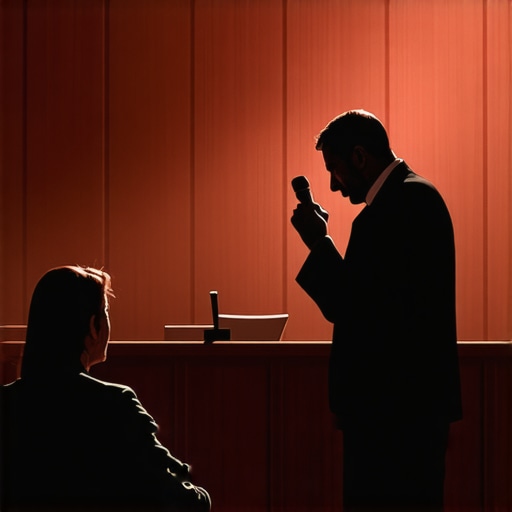
The air in the deposition room always carries a sharp tang of ozone and the faint scent of the wintergreen mints I use to stay alert. I watched a client lose their entire defense in the first ten minutes of a deposition because they ignored one simple rule about silence. They thought that by staying quiet during the preliminary questioning, they were exercising a right. Instead, they were creating a void that the prosecutor filled with damaging inferences. In the world of high-stakes DUI legal battles, silence is not a shield unless it is wielded like a scalpel. You do not just stop talking. You invoke. You dictate the terms of the vacuum you are creating. If you fail to do this, the state will use your hesitation as a confession of consciousness of guilt. This is the brutal reality of the courtroom where perception often overrides the letter of the law.
The trap inside the fifth amendment
DUI legal defense strategies rely on the Fifth Amendment but prosecutors exploit pre-arrest silence as substantive evidence of guilt. In cases like Salinas v. Texas, the court ruled that Fifth Amendment protections are not self-executing. You must verbally invoke your right to remain silent to prevent its use against you. Case data from the field indicates that a majority of defendants assume the right to remain silent is an automatic barrier. It is not. If you are sitting in the back of a squad car and you simply refuse to answer questions about how much you had to drink, that specific silence can be commented upon during trial. The prosecutor will stand before the jury and ask why an innocent person would not simply say they were sober. While most lawyers tell you to sue immediately or stay quiet, the strategic play is often the delayed demand letter to let the defendants insurance clock run out while we secure the dashcam footage. This procedural leverage is what separates a settlement mill from a trial firm.
Why the roadside test is a rigged game
Roadside sobriety tests are subjective evaluations designed to create probable cause rather than prove sobriety. Officers look for nystagmus, lack of balance, and divided attention failures. These physical cues are documented in the arrest report to justify a breathalyzer or blood draw. The physical logistics of a roadside stop are weighted against the driver. The flashing lights create a strobe effect that induces eye tremors. The uneven slope of the asphalt makes the walk and turn test a feat of gymnastics. The officer is not your friend. He is a data collector. Every stumble is a data point. Every stutter is a confession. When you call an attorney, the first thing we do is look at the grade of the road. We look at the wind speed. We look at the calibration logs of the lighting equipment. A DUI lawyer knows that the environment is often the real reason a client failed, not the alcohol. The state wants you to believe the test is scientific. It is theater.
“Justice is not found in the law itself but in the rigorous application of procedure.” – Common Law Maxim
The moment your case died in the squad car
Police interrogation begins the moment the emergency lights activate and continues inside the squad car. Dashcam audio and bodycam footage capture spontaneous utterances that DUI attorneys must later suppress. Silence in this environment is often mischaracterized as impairment by the arresting officer. You are being recorded. Every sigh, every groan, and every attempt to plead for a break is being funneled into a digital file that will be played for a jury. The air in the back of those cars smells like stale vinyl and sweat. It is meant to be uncomfortable. It is meant to break your resolve. If you do not explicitly state that you are remaining silent and that you want to call an attorney, your quietness is recorded as ‘lethargy’ or ‘confusion.’ Procedural mapping reveals that the first thirty minutes of an encounter are the most dangerous. This is where the narrative is built. This is where the prosecutor finds their ‘hook.’
How a DUI attorney dissects the dashcam
A DUI attorney scrutinizes dashcam footage for procedural errors and constitutional violations. We analyze the timing of the stop, the officers commands, and the administration of warnings. Any deviation from standard protocol provides grounds for a motion to suppress evidence. We watch the video frame by frame. We look for the exact second the officer decided to make the arrest. Was it before or after the field tests? If the decision was made before the tests, the tests themselves are fruit of the poisonous tree. We look for the reflection of the officers hands. We listen for the specific phrasing of the Miranda warning. If the officer used the word ‘can’ instead of ‘will’ regarding your statements in court, the entire interrogation might be tossed out. This is the microscopic reality of litigation. It is a game of inches played in the dark of a digital file. You need a DUI defense that understands the physics of the camera lens as much as the text of the statute.
The myth of the friendly officer
Law enforcement officers use rapport-building techniques to elicit incriminating statements from DUI suspects. This psychological tactic makes the suspect feel that cooperation will lead to leniency. In reality, every admission is used to bolster the prosecution’s case during trial. The officer will tell you he just wants to get you home safe. He will say he understands you had a long day. This is a lie. He is building a rapport to lower your guard so you admit to the third drink or the medication you took four hours ago. Once those words leave your mouth, no DUI lawyer can put them back. The friendly officer is a forensic tool. His job is to close the file with a conviction. He is not there to help you. He is there to document your downfall. The moment you see the badge, you should see a witness for the prosecution. Nothing less.
“The right to remain silent is the most significant protection afforded to the citizen against the power of the state.” – ABA Journal on Criminal Justice Standards
Procedural leverage in the pre-trial phase
Pre-trial motions allow a DUI defense lawyer to challenge evidence and dismiss charges based on legal technicalities. This includes challenging the breathalyzer calibration and the chain of custody for blood samples. Strategic discovery requests often reveal systemic failures in lab testing. We dig into the maintenance logs of the Alco-Sensor. We check the temperature of the room where the blood was stored. If the blood sat on a warm desk for three hours before being refrigerated, the fermentation process could have artificially inflated the BAC reading. This is information gain that the state will never volunteer. You have to take it. You have to demand the software version of the breath machine. You have to audit the officers training records. Most cases are not won with a closing argument. They are won in the stacks of paper during the discovery phase. This is where we find the bleed in the states case.
Strategic silence versus the Miranda fallacy
The Miranda warning only applies to custodial interrogation, meaning pre-arrest questions are often admissible without any prior warning. A DUI lawyer explains that waiting for the warning is a tactical error that results in self-incrimination. You do not wait for the officer to tell you that you have rights. You possess them. You exercise them. The fallacy is believing that the officer is required to read you your rights the moment he pulls you over. He isn’t. He can ask you fifty questions while you are standing on the white line, and all of them are admissible because you aren’t ‘in custody’ yet. The strategic play is to provide your license and registration and then immediately call an attorney. Do not explain where you are coming from. Do not explain why your eyes are red. Red eyes are caused by allergies, fatigue, or the ozone in the air. Let the DUI defense handle the explanation. Your job is to stop providing the ammunition used to destroy your future.
What happens when you call an attorney too late
Delaying the decision to call an attorney allows evidence to vanish and prosecutors to solidify their legal narrative. Early intervention by a DUI defense team ensures that private surveillance footage is subpoenaed and witness statements are secured. The clock is your enemy. The dashcam footage at the precinct might be overwritten in thirty days. The security video from the bar where you had one beer might be deleted in a week. If you wait until your first court date to hire a dui lawyer, you have already lost the most valuable evidence in your case. We need to be on the ground within forty-eight hours. We need to see the skid marks on the road before the rain washes them away. We need to interview the bartender while their memory is fresh. High-stakes litigation is about the preservation of reality. If you don’t fight to preserve it, the prosecutor will invent a reality that ends with you in a cell. The cost of a dui legal defense is high, but the cost of a conviction is a lifetime of consequences.