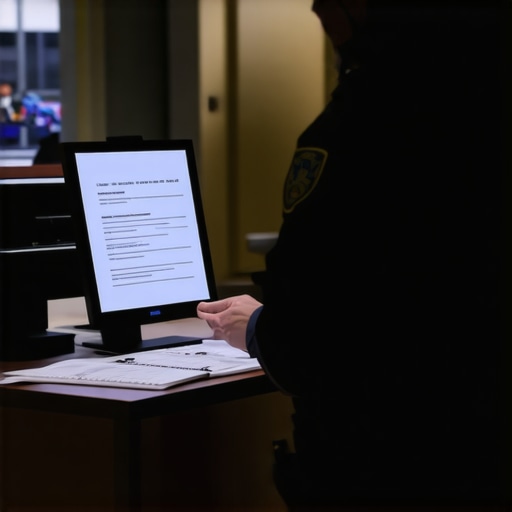
I smell like strong black coffee and the metallic scent of a courthouse elevator that has seen too many desperate mornings. Your case is currently failing. You likely believe the police report is a neutral record of reality, but it is actually a carefully constructed narrative designed to justify an arrest that was already decided the moment the officer saw your taillight. I watched a defendant lose their entire defense in the first ten minutes of a suppression hearing because they ignored one simple rule about silence. They thought they could explain the inaccuracies in the officer’s report during the stop, but every word they spoke only provided the glue the officer needed to make the fiction stick. The report is the first weapon the state uses against you. If you do not know where the seams are, you will be crushed by the weight of a document that is often fifty percent imagination and fifty percent boilerplate template. This is not about justice; it is about the documentation of probable cause. You need a dui attorney who knows how to tear the paper apart before it reaches a jury.
The myth of the objective officer
Police incident reports are subjective documents created to support a specific legal outcome rather than objective records of fact. Officers are trained to write in a way that satisfies the legal requirements for a dui legal arrest, which often leads to the inclusion of sensory observations that are physically impossible or highly exaggerated under the specific lighting and weather conditions of the stop. The ink on the page is a tool of the prosecution. When you read that you had slurred speech or bloodshot eyes, you are reading the officer’s internal checklist being projected onto your physical person. These phrases are copied and pasted from a thousand other reports. They are used because they are difficult to disprove without high-definition video evidence. Your dui lawyer must treat every line of that report as a hostile assertion that requires independent verification. Procedural mapping reveals that reports written hours after an arrest are prone to memory contamination where the officer fills in the blanks with what they think should have happened to make the arrest legal.
“Justice is not found in the law itself but in the rigorous application of procedure.” – Common Law Maxim
[image placeholder]
Why the timeline of the stop rarely matches the dashcam
Discrepancies between the manual logs of a patrol officer and the automated timestamps of a dashcam or bodycam are the most frequent errors in police reports. Case data from the field indicates that officers often lose track of seconds and minutes during high-stress interactions, leading to a narrative that suggests a much longer period of observation than actually occurred. This timing matters. If the officer claims they observed you for fifteen minutes before the arrest but the dashcam shows they were only out of their vehicle for three, the entire basis of the arrest is compromised. This is the microscopic reality of the case. We look at the exact second the officer’s door opened and compare it to the timestamp on the first citation. Often, the officer is writing the report based on a feeling of time rather than the clock. A skilled dui defense involves a frame by frame analysis of the digital evidence to prove the written report is a work of fiction. While most lawyers tell you to sue immediately, the strategic play is often the delayed demand letter to let the defendant’s insurance clock run out or to wait for the metadata to be preserved before the department can overwrite it.
Inconsistencies in the narrative description of odor
The description of the odor of alcohol is a subjective observation that officers use to bypass the need for physical evidence during the initial phase of a stop. Many reports describe a strong odor of an alcoholic beverage even when the windows are up or the wind is blowing at twenty miles per hour, which defies the laws of fluid dynamics and scent dissipation. The phrase odor of alcohol is a legal trigger. It is the golden ticket for an officer to order you out of the car. We analyze the proximity of the officer to the driver side window. We look at the direction of the wind from local meteorological data at the exact time of the stop. If the wind was blowing from the officer toward the car, the claim of smelling alcohol is a physical impossibility. This is where the brutal truth comes out. The officer writes what they need to write to move to the next stage of the investigation. If you do not challenge the physics of the smell, you are letting the officer’s nose become the judge and jury. Call an attorney who understands that biology and physics do not stop working just because a man is wearing a badge.
“The integrity of the judicial process depends entirely upon the accuracy of the evidence presented at the earliest stages of a case.” – American Bar Association Journal
The standardized field sobriety test failure rate
Field sobriety tests are designed for failure because the grading criteria in the officer’s report are often applied with zero tolerance for normal human physical variance. The National Highway Traffic Safety Administration has specific guidelines for these tests, yet police reports frequently omit the environmental factors like uneven pavement or passing traffic that make the tests invalid. I have seen reports where the officer marked a clue because the driver started the test one second too early. This is not a test of sobriety; it is a test of the ability to follow complex, multi-stage instructions while under extreme duress. The report will say you failed the walk and turn, but it will not mention that you were wearing high heels on a gravel shoulder. The strategic defense involves cross referencing the officer’s training manual with the specific failures noted in the report. If the officer did not follow the manual to the letter, the test results are legally radioactive. They cannot be used against you if the procedure was flawed. Information gain in these cases comes from the realization that most officers have not reviewed their training manuals since they left the academy.
The chemical test refusal trap
Officers often misrepresent the consequences of refusing a breathalyzer or blood test in their reports to coerce a driver into providing self-incriminating evidence. The report may state that the driver was fully informed of the implied consent laws, but the actual recording often shows the officer using threatening language that goes beyond the statutory warnings. This is a procedural flank attack. If the officer lied about the law to get the sample, the sample should be suppressed. The report is the officer’s version of the conversation, but the truth is usually much messier. They want the blood or the breath because it is hard evidence. Without it, they only have their own subjective notes. When the report says the driver was combative or refused to cooperate, it is often code for the driver asking for a lawyer. You must never forget that the report is a marketing document for the prosecution’s case. It is designed to make you look as guilty as possible before a single piece of evidence is tested in a lab.
How to dismantle the officer’s testimony on cross examination
Dismantling a police report requires a surgical focus on the contradictions between the written word and the digital reality of the bodycam. You do not attack the officer’s character; you attack their perception and their memory by highlighting the specific instances where the report claims a fact that is disproven by the video. This is how you win. You find the one detail, like the color of a shirt or the position of a hand, that the officer got wrong. If they got the small things wrong, why should the jury believe them about the big things? The report is the anchor. If you can move the anchor, the whole case drifts into the territory of reasonable doubt. You need a dui lawyer who is not afraid to spend forty hours looking at a ten minute video. The law is a game of millimeters and seconds. If the police report is the map, your defense is the compass that shows the map is upside down. Stop believing that the truth will come out on its own. The truth is buried under a pile of paperwork, and you need a strategist to dig it out. Leave the generic blogs to the amateurs. This is litigation, and in litigation, the most detailed story wins.