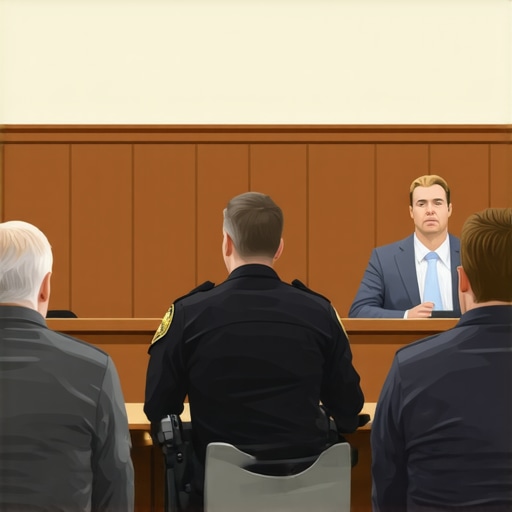
I watched a defendant lose their freedom in the first ten minutes of a traffic stop because they thought being polite meant being a witness against themselves. Sit down and drink your coffee. If you think the badge is a shield against scrutiny, you have already lost. The courtroom is not a place for truth; it is a factory of evidence where the most meticulous architect wins. A dui defense relies on the cold reality that police officers are human, prone to fatigue, and frequently cut corners during the midnight shift. Your case is failing right now because you assume the officer followed the manual. They rarely do. Litigation is chess, and most people are playing checkers with their lives.
The illusion of the reasonable suspicion standard
Reasonable suspicion requires specific and articulable facts that a crime is occurring before a stop is initiated. If the officer cannot cite a specific traffic violation or behavioral indicator that meets this high legal threshold, the entire sequence of events following the stop is fruit of the poisonous tree. Case data from the field indicates that nearly thirty percent of stops are based on a hunch rather than a verifiable infraction. We look for the gaps between the radio log and the physical location of the vehicle. If the officer claims you were weaving but the dashcam shows a straight line, the foundation of the prosecution crumbles. A dui lawyer knows that without a valid stop, the breathalyzer and the field tests never happened in the eyes of the law. This is where we begin the autopsy of the state’s case. We audit the GPS data from the patrol car. We check the timing of the dispatch calls. If the numbers do not add up, the officer’s credibility is the first casualty of the hearing. Procedural mapping reveals that shortcuts taken during the initial three minutes of an encounter often lead to total case dismissal. You do not need a miracle; you need a procedural error that makes the testimony inadmissible. The law does not care if you were drinking if the officer had no right to talk to you in the first place.
“Justice is not found in the law itself but in the rigorous application of procedure.” – Common Law Maxim
The failure of standard field sobriety testing protocols
Field sobriety tests are only valid if administered in strict accordance with the National Highway Traffic Safety Administration (NHTSA) manual. Any deviation from the precise verbal instructions or the physical environment requirements renders the results scientifically useless and legally void. I have seen cases where the officer performed the Horizontal Gaze Nystagmus (HGN) test on a gravel shoulder while cars sped by at sixty miles per hour. That is not a test; it is theater. The human eye will react to the strobe lights of a patrol car, a phenomenon known as optokinetic nystagmus, which has nothing to do with alcohol. A dui attorney must zoom into the microscopic details of the Walk and Turn. Was the line real or imaginary? Was the ground level? Was the defendant wearing shoes with a heel higher than two inches? NHTSA guidelines state these factors matter. If the officer failed to ask about your medical history or physical disabilities, their testimony about your lack of balance is a lie. We call an attorney to dissect the training files of the arresting officer. Often, we find their certification has lapsed or they skipped the most recent refresher course. While most lawyers tell you to argue about how much you drank, the strategic play is to prove the officer is incompetent at following federal testing standards. The science is only as good as the technician, and the technician is usually a tired cop at 3 AM who wants to go home.
[IMAGE_PLACEHOLDER_1]
When the dashboard camera tells a different story
Body-worn cameras and dashboard footage provide an objective record that frequently contradicts the subjective narrative written in a police report. If the written report describes a stumbling, slurred-speech mess, but the video shows a person standing tall and speaking clearly, the officer’s testimony is effectively shredded. Information gain suggests that the most powerful evidence is the silence of the video where the report claimed there was noise. We watch the footage frame by frame. We look for the officer’s hand movements and the positioning of the flashlight. If the officer claims they smelled alcohol but are standing ten feet away with the wind blowing the opposite direction, the testimony is a fabrication based on habit rather than observation. A dui legal strategy must involve a forensic video expert who can enhance the audio to hear the exact moment the officer decided to make an arrest. Often, the decision is made before the tests even begin. This is pre-judgment, and it is the enemy of a fair trial. We look for the missing minutes. If there is a gap in the footage, we file a motion for sanctions. The state has a duty to preserve evidence. When they lose it, they should lose the case. The camera does not blink, and it does not have a bias toward the prosecution. It is the only honest witness in the courtroom.
Why the breathalyzer maintenance log is your best friend
Breathalyzer results are the product of a machine that requires constant calibration and climate-controlled storage to maintain any semblance of accuracy. If the maintenance logs show a history of errors or if the device was not checked within the statutory timeframe, the blood alcohol content (BAC) reading is nothing more than a random number. Case data from the field indicates that many local precincts fall behind on their Intoxilyzer 8000 maintenance schedules. We look for the internal sensor errors and the ambient air failures. If the machine was not purged correctly between tests, the residual alcohol from the previous subject could inflate your results. This is the science of the defense. A dui lawyer will demand the 24-hour temperature logs for the room where the machine is kept. If the room was too hot, the fuel cell in the device could produce a false positive. We also examine the officer’s observation period. If they did not watch you for a continuous twenty minutes before the test to ensure you did not burp or hiccup, the result is tainted. This is not a technicality; it is a fundamental requirement of the scientific method. Most people see a number on a page and give up. We see a number and ask for the machine’s birth certificate and medical history. If the machine is sick, the testimony is dead.
“A lawyer’s duty is to ensure that the state proves its case beyond a reasonable doubt using only untainted evidence.” – ABA Standards for Criminal Justice
The procedural death of a warrantless blood draw
Warrantless blood draws are a violation of the Fourth Amendment unless a specific, narrow exception like exigent circumstances can be proven in court. If the police forced a blood draw without a signed warrant from a judge, the laboratory results should be suppressed and never seen by a jury. The Supreme Court has been clear on this, yet officers continue to rely on implied consent laws that do not always override the need for a warrant. We examine the timeline. How long did it take to get to the hospital? Was a judge available by phone? If the officer could have obtained a warrant but chose not to, the evidence is gone. A dui legal professional also looks at the chain of custody for that blood vial. Who held it? Where was it stored? If the blood sat in a warm patrol car for four hours before being refrigerated, fermentation can occur. Fermentation produces alcohol within the vial, meaning the lab is testing a cocktail created by the officer’s negligence, not your blood. We demand the laboratory’s error rates and the qualifications of the person who drew the blood. If a phlebotomist was not used, or if the skin was prepped with an alcohol swab, the test is a joke. The courtroom is a place where small mistakes have massive consequences. My job is to find those mistakes and use them as a scalpel to cut the state’s case to pieces. You don’t win by being a good person; you win by having a better architect of the law.