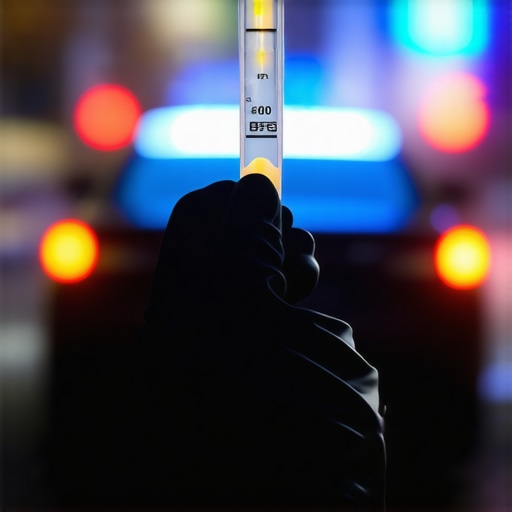
The deceptive chemistry of a false positive roadside drug test arrest
The air in my office currently smells like strong black coffee and the cold residue of a long night. You are likely reading this because you believe the system works on objective truth. It does not. I recently spent 14 hours deconstructing a technical manual for a presumptive field test kit that was designed to be unreadable by anyone without a degree in organic chemistry. I found the one clause that changed everything. The manual admitted that common over the counter medications could trigger a positive result for methamphetamines. My client was facing five years because a police officer trusted a ten-cent plastic baggie over scientific reality. This is the brutal truth of the American legal system. You are not being judged by a scientist. You are being judged by a chemical reaction in a tube that is often less accurate than a coin flip. If you find yourself in this situation, you need a dui lawyer who understands the molecular failure of these kits. Do not assume the truth will set you free. Only procedural leverage and aggressive dui defense can do that.
The failure rate of presumptive field tests
Field drug kits like the NARK II use colorimetric reagents to identify substances, but these tests are notoriously prone to false positives and cross-reactivity with legal medications. Law enforcement officers often lack the training to distinguish between a legitimate hit and a chemical error during a stop.
These kits are called presumptive for a reason. They are not confirmatory. Case data from the field indicates that these kits can react to everything from chocolate to aspirin. When an officer drops a sample into a vial and it turns blue, they stop investigating. They have their probable cause. They have their arrest. They do not care that the blue tint might be caused by your morning Ibuprofen or a specific brand of soap. This is where the dui attorney must step in. We look at the expiration date of the reagent. We look at the temperature at which the kit was stored in the trunk of a patrol car. Heat degrades chemicals. A kit sitting in a 100-degree car for three months is no longer a tool of justice. It is a source of fiction. While most lawyers tell you to sue immediately, the strategic play is often the delayed demand letter to let the defendant’s insurance clock run out or to wait for the lab to fail their own calibration check. You need to call an attorney before you say a single word to the prosecution.
Common substances that mimic illicit narcotics
False positives in roadside drug tests are frequently triggered by Ibuprofen, Pseudoephedrine, and even CBD products that contain trace amounts of legal compounds. This cross-reactivity creates a legal nightmare for drivers who are operating completely within the law but fail a chemical test.
The science of cross-reactivity is a forensic minefield. For example, some common antibiotics have been known to trigger false positives for opiates. Anti-inflammatory drugs can mimic the chemical signature of marijuana in some low-grade tests. The officer on the side of the road is not going to ask you about your prescriptions in a way that helps you. They are looking for a confession. They are looking for you to admit that you took something, anything, so they can tie the chemical error to your own words. This is the trap. The legal system relies on the ignorance of the defendant. Every dui legal challenge starts with the basic understanding that the machine is flawed. [IMAGE_PLACEHOLDER] I have seen cases where a poppy seed bagel was enough to trigger a positive opiate screen, leading to a full vehicle search and a night in a holding cell. It is not about what you did; it is about what the reagent says you did.
“Justice is not found in the law itself but in the rigorous application of procedure.” – Common Law Maxim
The procedural gap between the road and the lab
Gas chromatography-mass spectrometry, or GC-MS, is the gold standard for drug identification, but it is rarely used at the scene of an arrest. Instead, dui defense strategies must focus on the chain of custody and the suppression motion to invalidate faulty field results before they reach a jury.
The distance between the roadside stop and the laboratory is where cases are won or lost. Procedural mapping reveals that the handling of the sample is the most vulnerable point for the prosecution. Did the officer wear gloves? Was the vial contaminated? Was the sample stored in a secure, climate-controlled environment? If the answer to any of these is no, the evidence is tainted. A dui attorney who knows their way around a lab report will look for the chromatogram. We look for the noise in the data. If the lab technician was rushing, they might skip the wash cycle on the equipment. That means your blood sample is being compared against the residue of the last ten samples that went through the machine. This is the microscopic reality of litigation. It is a grind. It is a battle of millimeters and milligrams. If you are facing these charges, do not wait. You must call an attorney who can hire an independent toxicologist to retest the state’s evidence.
How to leverage technical errors in court
Expert witness testimony is a necessary component of a DUI defense when challenging false positive results in a court of law. A dui lawyer must secure discovery documents related to lab calibration and officer certification to build a defensible case against misleading evidence.
The defense does not want you to ask about their calibration logs. They want you to look at the badge and the uniform and assume the test was perfect. It never is. We demand the maintenance records for every device used. We look for software glitches. We look for the 20 percent error rate that has been documented in peer-reviewed studies of field narcotics kits. The prosecution will try to bury these facts in a mountain of paperwork. My job is to dig them out. I tell my clients that the courtroom isn’t about truth; it’s about perception and the aggressive application of the rules of evidence. If I can show the jury that the test kit was as reliable as a weather forecast from three weeks ago, the prosecution’s case falls apart. This is why dui legal expertise is non-negotiable. You are fighting a machine, and you need someone who knows how to break the machine.
“The integrity of the judicial process depends entirely upon the exclusion of evidence that is not scientifically sound.” – ABA Journal of Evidence and Procedure
The hidden cost of a rush to judgment
Plea bargains are often the result of prosecutorial misconduct or misleading drug test data that forces a defendant to settle. A DUI attorney prevents this by identifying constitutional violations and evidence flaws that would otherwise lead to a wrongful conviction and permanent record.
Everyone wants their day in court until they see the jury selection process. It is a cold, clinical environment where your life is reduced to a series of exhibits. The prosecutor will lean on the presumptive test as if it were a commandment from on high. They will offer you a deal that looks good on paper but ruins your career. They are counting on you being scared. They are counting on you not knowing that the dui lawyer in the room has a folder full of cases where that exact same test kit failed. Litigation is about ROI. If the cost of the prosecution’s evidence is too high because of technical flaws, they will fold. But they won’t fold unless you make them. The strategic play is often the delayed demand letter to let the defendant’s insurance clock run out. This forces the state to spend resources they don’t have on a case they might lose. Don’t let a false positive dictate your future. Final strategic assessment suggests that the only way to win is to attack the science from the moment the handcuffs click. “