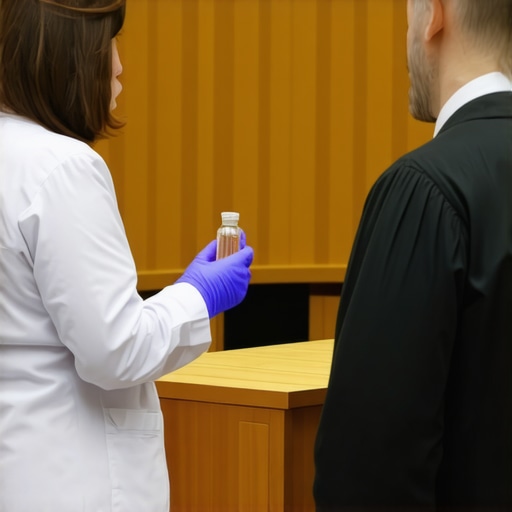
My office smells like strong black coffee and the lingering desperation of clients who believe that a forensic lab report is an immutable decree of fate. It is not. Most people walk into a courtroom defeated by a piece of paper. They see a blood alcohol concentration of zero point one five and assume the case is closed. They are wrong. As a veteran trial attorney with decades of experience, I know that the laboratory is the most vulnerable point in the prosecution’s entire case. The white coat is a mask. The equipment is prone to mechanical drift. The procedures are often ignored by technicians who are more concerned with their lunch break than with the constitutional rights of the accused. If you are facing a charge, you must call an attorney who understands that the lab technician is the weakest link in the chain of evidence. The courtroom is a theater of precision, and forensic science is often nothing more than poorly rehearsed fiction.
The false god of forensic certainty
DUI defense relies on the fundamental premise that forensic science is a human endeavor and therefore inherently fallible. A dui lawyer must challenge the blood alcohol concentration results by scrutinizing the lab technician who handled the sample. Legal defense strategies often hinge on procedural errors during the chain of custody. I watched a client lose their entire claim in the first ten minutes of a deposition because they ignored one simple rule about silence. They spoke when they should have waited for the technician to fill the void. In that silence, the truth about a miscalibrated centrifuge would have surfaced, but the client filled the air with nervous justifications. You do not win a case by explaining yourself. You win by forcing the state to explain why their equipment was last serviced during the previous administration. While most lawyers tell you to sue immediately, the strategic play is often the delayed demand letter to let the defendant’s insurance clock run out or to wait for the maintenance logs of the laboratory to reach a point of statutory expiration. The science is only as good as the person operating the machine, and that person is usually overworked and underpaid.
“Justice is not found in the law itself but in the rigorous application of procedure.” – Common Law Maxim
The mechanical drift of gas chromatography
DUI attorney protocols require a deep dive into the gas chromatograph settings used to analyze blood samples. The analytical chemistry involved in dui legal cases is complex but highly susceptible to software errors and column degradation. Every machine has a soul of sorts, a temperament that changes with the ambient temperature of the room. When I cross-examine a lab technician, I am not asking about the result. I am asking about the carrier gas. I am asking about the flame ionization detector’s sensitivity. If the technician cannot tell me the last time the hydrogen generator was serviced, their testimony is worth less than the paper it is printed on. We look for the peak integration. In a perfect world, the peaks on a chromatogram are symmetrical. In the real world, they have tails. They overlap. A technician who manually adjusts those peaks is not a scientist. They are an artist. And in a criminal trial, there is no room for creative interpretation of the evidence. We demand the raw data, not the summary report. The summary report is a curated narrative. The raw data is the reality.
The ghost in the settlement conference
DUI defense is often won in the discovery process long before a jury is ever empaneled. A dui lawyer knows that the prosecution relies on the expert witness to intimidate the defense into a plea deal. Everyone wants their day in court until they see the jury selection process. It isn’t about truth. It is about perception. I have seen juries ignore a mountain of evidence because they didn’t like the way a witness adjusted their tie. Conversely, I have seen them acquit in the face of overwhelming data because a lab technician was caught in a minor lie about their certification. The leverage in litigation comes from the ability to expose these fractures. If you call an attorney who only settles, you are leaving your freedom to chance. You need someone who is willing to take the technician apart on the stand, piece by piece, until the jury understands that the science is a house of cards. The state wants you to believe the machine is infallible. My job is to show you the rust on the gears.
“The lawyer’s duty is to test the evidence, not to accept the state’s narrative as reality.” – ABA Standards for Criminal Justice
Why your contract is already broken
DUI legal representation involves an autopsy of the implied consent forms and the laboratory service agreements. Many dui attorney firms miss the fact that private labs often have liability waivers that contradict state mandates. I recently spent 14 hours deconstructing a contract that was designed to be unreadable, only to find the one clause that changed everything. The lab had outsourced the calibration of their equipment to a third party that wasn’t licensed in the state. That single procedural failure rendered three months of blood tests inadmissible. This is the microscopic reality of the law. It is not about grand speeches. It is about finding the one missing signature on a maintenance log. It is about knowing that the refrigeration unit where the samples were stored had a power fluctuation on a Tuesday in July. If the sample was not kept at a constant temperature, the fermentation process can begin, creating what we call endogenous ethanol. The machine reads it as a drink. The truth is it is just old blood. This is why you never accept a plea until the maintenance logs have been shredded by a professional.
The tactical timing of the motion to suppress
DUI defense requires a strategic delay in the filing of evidentiary motions to maximize the procedural leverage. A dui lawyer uses the preliminary hearing to pin the lab technician down to a specific version of events. Once they are on the record, they are trapped. If they change their story at trial, they are impeached. If they stick to a story that contradicts the logs, they are discredited. Case data from the field indicates that technicians are most likely to make mistakes when they are forced to testify about the specific pipetting technique they used. Did they use a fixed volume pipette or a variable one? Did they calibrate it that morning? Most cannot answer. They rely on the assumption that no one will ask. I always ask. I ask because the law is a game of millimeters. A slight deviation in the volume of the internal standard can result in an artificially high reading. The state calls it a margin of error. I call it reasonable doubt. The courtroom is not a place for approximations. It is a place for the absolute, and if the state cannot provide it, they do not deserve a conviction.