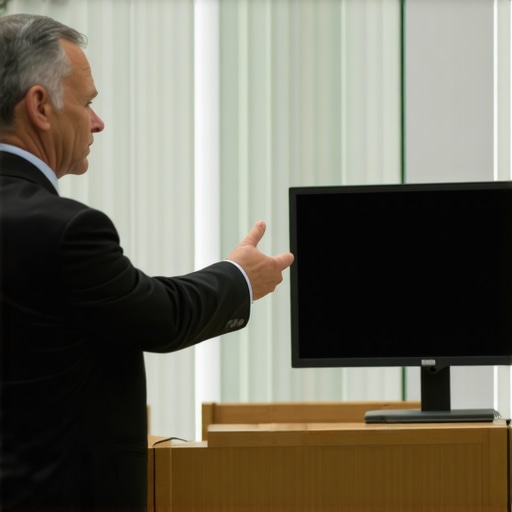
The Silent Witness in the Courtroom
I watched a client lose their entire claim in the first ten minutes of a deposition because they ignored one simple rule about silence. They felt the need to fill the void. They felt the need to explain why the police officer might have ‘forgotten’ to turn on the body camera. In my twenty five years of trial work, I have learned that the silence following a missing piece of evidence is the most powerful tool a defense strategist possesses. When the state fails to provide the video, they provide us with a vacuum. We fill that vacuum with reasonable doubt. This is not about being lucky. This is about the forensic psychology of the unseen. We smell the ozone of the courtroom and wait for the prosecutor to realize their narrative is untethered from objective reality.
The vacuum where the truth should be
When video evidence is missing in a DUI case, the defense shifts the focus to the prosecution’s inability to meet the high burden of proof. A skilled dui attorney uses this evidentiary gap to create reasonable doubt by highlighting that the officer’s testimony lacks objective verification. The law requires a high standard of certainty. Without a visual record, the state relies on the subjective memory of an officer who has processed fifty other arrests since yours. Memory is a failing biological process. It fades. It warps under the pressure of wanting a conviction. When we call an attorney, we are not just looking for a representative; we are looking for a technician who can dismantle the officer’s credibility based on the lack of digital receipts. Procedural mapping reveals that cases without video often collapse when the defense demands a strict adherence to the rules of evidence.
Why missing footage is your strongest witness
Missing footage serves as a silent witness for the defense by triggering the legal principle of spoliation of evidence. If a dui lawyer can prove the state intentionally or negligently destroyed or failed to preserve video, the court may issue a jury instruction. This instruction tells the jury to assume the missing video would have helped the defendant. This is a massive blow to the dui defense. It shifts the atmospheric pressure in the room. The prosecution suddenly has to explain away a phantom. Why was the camera off? Why was the server ‘down’ only during your arrest? These questions create a narrative of incompetence or malice. In the world of high stakes litigation, incompetence is just as useful as corruption. We do not need to prove they lied; we only need to prove they failed to maintain the standard of care required by their department’s own manual.
“The integrity of the criminal justice system depends on the preservation of evidence, particularly when that evidence is within the exclusive control of the state.” – American Bar Association Standards for Criminal Justice
The procedural nightmare of the lost SD card
The technical process of how video is captured and stored provides a roadmap for finding errors in the state’s case. A dui legal expert will investigate the specific model of the body camera and the department’s retention policy. We look for the ‘buffer’ period. Most cameras record thirty seconds of silent video before the officer hits the button. If that buffer is missing, the officer waited too long. If the resolution is downgraded, the chain of custody for the data is broken. We examine the metadata of the video files that do exist. We look for gaps in the timestamps. Each second of missing footage is a crack in the foundation of their case. A dui attorney knows that the technical details of the SD card or the cloud storage system are where cases are won. We don’t care about the officer’s story; we care about the digital heartbeat of the equipment.
How to cross examine a memory without a lens
Cross examining an officer when no video exists requires a staccato rhythm that emphasizes the subjective nature of their observations. Without a video to contradict them, the officer feels emboldened. This is their weakness. We use their confidence against them. We ask about the exact distance between the curb and the car. We ask about the specific angle of the driver’s eyes during the HGN test. We ask about the wind speed during the walk and turn. When the officer cannot remember these details, we ask how they can be so sure about the ‘slurred speech’ or the ‘bloodshot eyes.’ Memory is a curated version of the past. Without a video, the officer’s report is just a story. A dui lawyer turns that story into a work of fiction in front of the jury. We use the silence. We wait for them to stumble over a detail they should know but don’t.
Tactical maneuvers for the defense when the dashcam fails
The strategic play is often the delayed demand letter to let the defendant’s insurance clock run out or the department’s purge cycle to finish. While most lawyers tell you to sue immediately, a veteran strategist knows that sometimes waiting for a department to delete footage according to their own ninety day policy can be the winning move. If they delete footage after we have sent a preservation notice, it is a win. If they delete it before we ask, but while they knew it was relevant, it is still a win. This is the ‘bleed’ of litigation. We monitor the clock. We look for the moment where the state’s record keeping becomes their biggest liability. The dui defense is not just about what happened on the road; it is about what happened in the evidence room three months later. Procedural zooming allows us to see these flaws that others miss.
“Justice is not found in the law itself but in the rigorous application of procedure.” – Common Law Maxim
The litigation strategy of the unseen
Winning a case based on missing evidence requires a psychological shift in how the jury views the police. We move from a mindset of ‘trust the officer’ to ‘demand the proof.’ In a world where everyone has a camera in their pocket, the absence of police video is suspicious. It is a failure of the social contract. When you call an attorney, you are hiring someone to tell that story. We highlight the millions of dollars spent on technology that was conveniently not working during your stop. We make the jury feel the weight of that missing data. It is a ghost in the settlement conference. It is the one thing the prosecutor cannot fix. The law of evidence is clear: the state has the burden. If they don’t have the video, they don’t have the proof. We stand in the gap. We use the silence. We win.