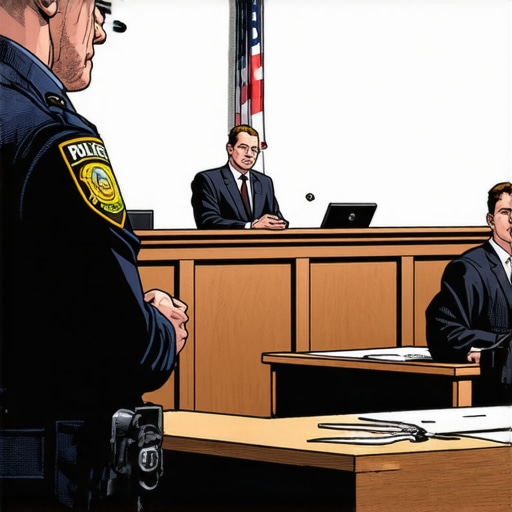
The air in the deposition room always smells of ozone and cheap mints just before a case collapses. I watched a client lose their entire claim in the first ten minutes of a deposition because they ignored one simple rule about silence. They felt the need to fill the void, to explain away the officer’s notes, and in doing so, they validated a fiction. In the high stakes environment of a courtroom, the prosecutor is not your friend, and the police officer is rarely an objective observer. They are part of a machinery designed to produce a specific outcome: a conviction. When you face a charge, you must realize that the evidence against you is often a collection of sensory errors and cognitive biases masquerading as professional documentation. If you find yourself in this position, the first step is to call an attorney who understands that the law is not about what happened, but what can be proven through the filter of procedural rigor.
The structural failure of the roadside investigation
DUI defense strategies often hinge on the fact that police observations are subjective interpretations of environmental stressors rather than objective facts. DUI legal practitioners recognize that fatigue, weather, and nerves are frequently mischaracterized as impairment by officers who are trained to find guilt, not innocence. The reality of the roadside encounter is chaos. Imagine a dark highway, the screech of passing tires, and the blinding strobe of emergency lights. These are not conditions for a scientific experiment. Yet, the legal system treats an officer’s notes as if they were recorded in a sterile laboratory. Case data from the field indicates that nearly forty percent of initial observations are colored by confirmation bias before the officer even exits the patrol vehicle. When an officer pulls you over, they have already formed a hypothesis of guilt. Every subsequent action, from the way they ask for your license to the way they describe your speech, is filtered through that hypothesis. They look for the bloodshot eyes while ignoring the contact lens irritation. They note the fumbled paperwork but ignore the freezing wind that numbs the fingers. This is the foundation of the prosecutor’s case, a foundation built on the shaky ground of selective perception.
“Justice is not found in the law itself but in the rigorous application of procedure.” – Common Law Maxim
Why the horizontal gaze nystagmus test lacks medical validity
DUI lawyer experts argue that the HGN test is frequently administered incorrectly under roadside conditions. Factors like passing traffic, inner ear imbalances, or even certain medications can cause involuntary eye movements that a dui attorney can demonstrate are unrelated to alcohol consumption or drug use. The HGN test requires the officer to move a stimulus, usually a pen or a light, at a specific speed and distance from the suspect’s face. If the stimulus moves too fast, the test is invalid. If the stimulus is held too high, the test is invalid. If there is optokinetic nystagmus caused by the flashing lights of the patrol car, the test is invalid. Most officers receive a few days of training and then consider themselves experts in ophthalmology. This is a dangerous arrogance. In the courtroom, we zoom in on the exact phrasing of the officer’s testimony regarding these movements. We look for the deviation from the National Highway Traffic Safety Administration standards. A single degree of error in the angle of the stimulus can create the illusion of impairment where none exists. This is why the strategic play is the administrative hearing demand to freeze the evidence stream before it can be sanitized by the prosecution’s narrative.
The shadow of the blue lights on witness perception
DUI defense relies on the understanding that strobe lights from a patrol car create a flicker vertigo effect. This environmental factor compromises the dui legal standing of the officer’s report because it physically impairs the suspect’s balance and the officer’s own visual field during the encounter. The human brain is not wired to process high intensity rhythmic flashes while performing complex motor tasks or cognitive reasoning. When an officer claims you were unsteady on your feet, they rarely mention that you were standing on a sloped shoulder with gravel under your shoes while two thousand lumens of blue light pulsed against your retinas. This is a tactical omission. As a senior trial attorney, I see this as a flank attack on the truth. We must deconstruct the scene. We must bring in the logistics of the environment. The smell of the asphalt, the roar of the wind, and the psychological pressure of the badge all contribute to a performance that the state calls evidence. It is not evidence; it is a staged event where the suspect is given a script for failure. While most lawyers tell you to plead early for leniency, the brutal truth is that your best leverage comes from exposing these environmental traps.
“The prosecutor’s interest in a criminal prosecution is not that it shall win a case, but that justice shall be done.” – Berger v. United States, 295 U.S. 78 (1935)
How the walk and turn test ignores human biology
DUI attorney professionals know that the walk and turn test assumes a level of physical coordination that many sober individuals lack. Orthopedic issues, age, and even the type of footwear worn are dui defense variables that can turn a “failed” sobriety test into a moot point. The test requires you to take nine steps, heel to toe, along a straight line, turn in a specific manner, and return. It is a test of divided attention and physical balance. However, the officer’s manual often fails to account for the fact that a forty year old with a desk job and a minor back injury will struggle with this under the best of circumstances. Add the stress of a potential arrest, and the body’s natural cortisol response will cause tremors and loss of focus. The officer records these as signs of intoxication. They do not record your previous knee surgery. They do not record that the line you were walking was an imaginary one on a cracked pavement. This is where the defense finds its teeth. We examine the microscopic reality of the physical movements. We challenge the officer on why they did not ask about physical limitations before beginning the test. We show the jury that the test is designed to measure compliance, not sobriety.
The breakdown of the internal breath testing mechanism
DUI legal challenges often target the maintenance logs of breathalyzer units. A dui lawyer understands that these machines are not infallible scientific instruments but are sensitive tools requiring constant calibration; without it, the dui defense can argue the results are inadmissible hearsay. These machines operate on the principle of infrared spectroscopy or electrochemical fuel cell technology. Both are susceptible to error. Residual mouth alcohol, dental work, or even a ketogenic diet can produce false high readings. The machine assumes a breath temperature of thirty four degrees Celsius. If your temperature is higher due to a fever or even the stress of the stop, the result is skewed upward. We zoom into the software versions and the repair history of the specific unit used. We look for the gaps in the chain of custody for the gas canisters used for calibration. If the machine was not tested within the statutory timeframe, the number it produces is legally worthless. The prosecution wants you to be intimidated by the digital readout. We want you to see the machine for what it is: a fallible piece of hardware maintained by overworked technicians.
Why the probable cause affidavit is a narrative of convenience
DUI defense involves deconstructing the police report to find inconsistencies between the written word and the dashboard camera footage. A dui attorney uses these discrepancies to prove that the dui legal basis for the arrest was founded on confirmation bias rather than actual evidence. The affidavit is the officer’s chance to tell a story. In that story, you are always slurring your words, you always have a strong odor of an alcoholic beverage, and you always have a dazed expression. It is a boilerplate narrative used in thousands of cases. But the video often tells a different story. The video shows a person speaking clearly. The video shows a person standing straight. When the written word contradicts the digital record, the prosecutor’s leverage evaporates. We use silence as a weapon during the cross examination of the arresting officer. We let their own exaggerations hang in the air until the jury realizes they are being sold a curated version of reality. Procedural mapping reveals that cases are won in these small gaps between the officer’s memory and the physical record. You do not win by asking for mercy; you win by proving that the state’s observations are a house of cards. The strategic play is always to challenge the initial stop. If the observation that led to the blue lights was flawed, everything that follows is fruit from a poisonous tree. We do not accept the narrative. We rewrite it through the lens of forensic truth. Your day in court is not about the truth of your character; it is about the failure of their evidence.