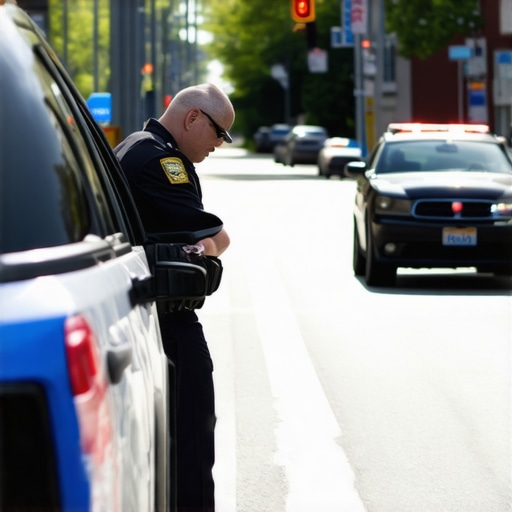
The Hidden Trap of Consenting to a Vehicle Search During a Traffic Stop
I watched a client lose their entire claim in the first ten minutes of a deposition because they ignored one simple rule about silence. It happens on the asphalt long before it reaches the mahogany tables of a law firm. The officer leans in, flashlight beam cutting through the cabin, and asks a simple question. Do you mind if I take a look? Your heart is hammering against your ribs. You want to look like a law-abiding citizen. You think cooperation is your ticket home. You are wrong. That one word, yes, is the sound of your constitutional shield shattering. I have spent decades in courtrooms watching good people get buried by their own misplaced desire to be helpful. The law does not reward your helpfulness. It rewards your silence and your insistence on procedure. This is the brutal reality of the legal system. If you find yourself in this situation, you must call an attorney immediately. The prosecutor does not care that you were just trying to be nice. They care about the bag of seeds found under your floor mat or the prescribed medication in an unmarked bottle. Your consent is a gift to the state. Stop giving it away.
The illusion of cooperation
Consenting to a vehicle search during a stop is a voluntary waiver of Fourth Amendment rights. It grants police carte blanche to dismantle your car interior, often leading to arrests for items you did not know were there or misinterpreted evidence. Never waive this right under pressure. Police officers are trained in the psychology of the roadside encounter. They use a technique called the knock and talk but adapted for the driver window. They create a false sense of urgency. They make you feel that if you refuse, you are admitting guilt. This is a tactical lie. Refusal is not evidence of a crime. It is the exercise of a right. When you give consent, you are telling the court that the officer did not need a warrant. You are telling the court that you didn’t care about your privacy. In the world of dui legal strategy, this is a catastrophic mistake. The moment you say yes, the officer can spend an hour tearing out your trunk lining. They will find the ghost of a joint from three years ago. They will find a spent shell casing from a hunting trip. Each item is a new brick in the wall of your prosecution. You need a dui lawyer who knows how to handle these violations, but it is better to never give them the evidence in the first place.
“Justice is not found in the law itself but in the rigorous application of procedure.” – Common Law Maxim
Why your innocence won’t save you
Innocence is a legal conclusion, not a shield during a roadside stop. Police look for probable cause, and consent provides it instantly. Even if you are clean, innocent items can be used to build a narrative of guilt, especially in complex dui legal cases. I have seen cases where a bottle of mouthwash or a spilled energy drink was used as evidence of impairment. The officer smells something. They are not scientists. They are human beings with biases. If they find a legal substance that they can characterize as suspicious, they will. This is why the advice from a dui attorney is always the same. Do not talk. Do not search. Do not perform tests. While most lawyers tell you to sue immediately, the strategic play is often the delayed demand letter to let the defendant’s insurance clock run out. This applies to the initial stop as well. You are building a record. If you remain silent and refuse the search, the officer must find another legal path. If they cannot, the evidence they find anyway might be suppressed. If you consent, that evidence is likely stay in the record forever. The dirt on your floorboards is not just dirt to a prosecutor. It is evidence of a chaotic lifestyle or drug use. Do not give them the chance to misinterpret your life.
The physics of a roadside interrogation
Roadside interrogations are designed to elicit self-incrimination through physical and mental exhaustion. Officers use the environment, the flashing lights, and the noise of traffic to disorient drivers into giving consent. Strategic silence is the only effective defense against these tactics. Consider the logistics. You are sitting in a low seat. The officer is standing above you. The blue and red lights are strobing in your rearview mirror. This is a power dynamic designed to break your will. The officer might mention that they can bring a K-9 unit out if you don’t cooperate. This is often a bluff. Even if it isn’t, the K-9 sniff has strict legal limits. According to the Supreme Court, a dog sniff cannot unreasonably prolong a stop. If you give consent, the time limit vanishes. You have just authorized a permanent stay on the side of the road. Your dui defense begins the second those lights turn on. If you call an attorney from the shoulder of the road, you are already ahead of the game. You need to understand that the officer is looking for the odor of alcohol or the sight of dilated pupils. They are looking for any reason to escalate a simple speeding ticket into a life-altering felony. Your consent is the fastest way for them to achieve that goal.
“A seizure that is justified solely by the interest in issuing a warning ticket to the driver can become unlawful if it is prolonged beyond the time reasonably required to complete that mission.” – Rodriguez v. United States
How a dui lawyer dismantles a bad search
A dui lawyer dismantles a bad search by scrutinizing the officer’s initial reason for the stop and the subsequent timeline. If the officer deviated from the original mission without independent reasonable suspicion, the search results may be thrown out in court. We look at the body camera footage. We look at the timestamp on the radio dispatch. We look for the exact moment the officer stopped investigating a broken taillight and started a fishing expedition. If you gave consent, my job becomes much harder. I have to argue that your consent was coerced. Coercion is difficult to prove. It requires showing that the officer used threats or overbearing force. If you simply said okay because you were nervous, the court will likely find that consent was valid. This is why the phrase I do not consent to searches must be your mantra. Say it clearly. Say it once. Then stop talking. Every word you speak after that is a risk. Every explanation you offer is a potential contradiction. The legal system is a game of margins. Do not give the state a head start by opening your trunk.
The myth of the nothing to hide defense
The nothing to hide defense is a psychological trap that leads to accidental self-incrimination. No vehicle is truly empty of potentially incriminating context when viewed through the lens of a suspicious law enforcement officer. You might have a gym bag with some powder in it. It is protein powder, but to a field test kit, it might show a false positive for an illegal substance. Now you are in handcuffs. You are being processed. You are calling a dui lawyer from a jail cell. All because you thought you had nothing to hide. The reality of the modern legal system is that everything can be hidden or twisted. A dui attorney sees this every day. A bottle of water can be questioned. A pair of sunglasses can be used to claim you were hiding your eyes. The interior of your car is a private space for a reason. Keep it that way. If the officer had enough evidence to search your car without your help, they would not be asking for your permission. The very fact that they are asking means they know they are on thin ice. Do not give them a bridge to cross. Your future depends on your ability to say no and stay silent.