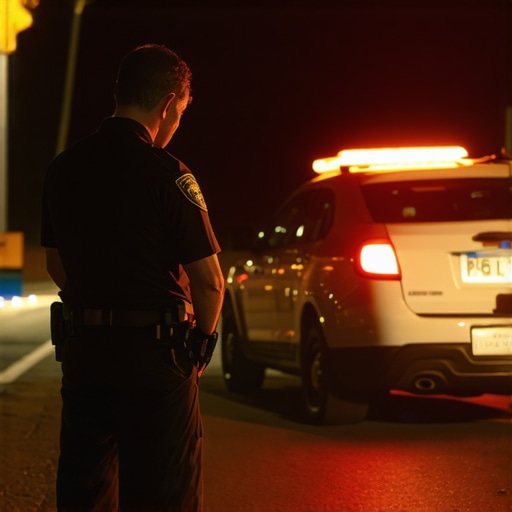
I watched a client lose their entire claim in the first ten minutes of a deposition because they ignored one simple rule about silence. They thought being helpful would make the officer like them. It did not. It gave the prosecution a confession disguised as a conversation. Law is not a social gathering. It is a forensic evaluation where every syllable is a potential brick in your prison cell. My office smells like strong black coffee because that is the only thing that keeps me alert to the lies told in police reports. If you are standing at a sobriety checkpoint, you are already being measured for a suit of orange. This is how you stop the tape and protect your future before you even call an attorney.
The reality of the flashlights and the badges
DUI lawyer experts know that a sobriety checkpoint is a highly regulated environment where legal rights often collide with police procedure. If you are stopped, you must provide your license and registration, but you are not obligated to engage in small talk or admit to consuming any substances during the arrest process or DUI defense phase.
The checkpoint is a theater of intimidation. The blinding LED light in your eyes is not just for safety; it is a tool to induce pupil dilation or detect nystagmus before the official testing even begins. Most drivers panic. They smell the asphalt, the exhaust fumes, and the cold air, and they start talking to fill the silence. That is your first mistake. Case data from the field indicates that the first sixty seconds of a stop determine the trajectory of the entire case. If the officer smells alcohol, they will use every tactic to get you out of the car. You must realize that the checkpoint is a search. While the Supreme Court has ruled these stops constitutional in cases like Michigan Dept. of State Police v. Sitz, they must follow strict operational guidelines. If the lighting is insufficient or the selection of vehicles is arbitrary rather than mathematical, the entire operation may be invalid. A dui legal expert will look for these procedural cracks immediately.
“Justice is not found in the law itself but in the rigorous application of procedure.” – Common Law Maxim
What the Fifth Amendment actually means in your car
The Fifth Amendment provides a right to remain silent that is your primary shield when facing a DUI attorney or a prosecutor later. You are not required to answer questions about where you are coming from or how much you had to drink, as these are legal counsel matters that can be handled later.
I tell my clients that silence is not an admission of guilt. It is a constitutional right. When an officer asks, “Have you been drinking tonight?” any answer other than a polite refusal to discuss your evening is a trap. If you say “just two beers,” you have admitted to consuming a controlled substance. If you say “none,” and their machine later claims otherwise, you are a liar. Both scenarios benefit the state. The strategic play is often the delayed response. You provide your documents and state, “I am exercising my right to remain silent and I would like to speak with my lawyer.” This prevents the officer from noting “slurred speech” or “incoherent responses” in their report. Procedural mapping reveals that cases with minimal verbal interaction are significantly harder for the prosecution to win. They need your words to build the bridge to a conviction. Do not give them the lumber.
The hidden flaws in field sobriety testing
Standardized Field Sobriety Tests or SFSTs are designed by the NHTSA to be difficult even for sober individuals, making them a cornerstone of DUI legal defense. These tests are subjective and depend entirely on the officer’s perception, which is why you need a dui lawyer to challenge the results in court.
Consider the Horizontal Gaze Nystagmus test. The officer holds a pen or stylus twelve to fifteen inches from your nose. They are looking for a distinct jerking of the eye. However, dozens of medical conditions, including inner ear issues or simple fatigue, can cause the same effect. Then there is the Walk and Turn. You are told to walk a straight line, heel to toe, for nine steps. If you lose your balance by a fraction of an inch or start too early, it is marked as a “clue” of impairment. These tests are not about balance; they are about the ability to follow complex, multi-part instructions under extreme stress. While most lawyers tell you to cooperate, the strategic play is often to politely decline these voluntary tests. There is no legal penalty for refusing the physical gymnastics on the side of the road in most jurisdictions, though your license may face administrative pressure. Information gain suggests that refusing the physical tests denies the officer the “probable cause” they need to move to a formal arrest.
“The lawyer’s duty is not to the truth but to the client’s defense within the rules of the court.” – American Bar Association Journal
Why your consent is a trap for the unwary
Implied consent laws mean that by driving, you have agreed to chemical testing, but a dui defense strategy often hinges on whether the arrest was lawful. If you are asked to take a breathalyzer, you must understand the difference between the portable roadside unit and the evidentiary machine at the station.
The portable breath test used at the scene is notoriously unreliable. It is sensitive to temperature, radio frequency interference, and even the presence of mouthwash or recent acid reflux. In many states, the results of this handheld device are not even admissible in court to prove intoxication; they are only used to justify the arrest itself. If you blow into that machine, you are handing the officer the handcuffs. The evidentiary machine at the police station is more sophisticated, but it is still just a computer running an algorithm. It assumes every human has the same blood to breath partition ratio. This is a scientific fallacy. Your dui attorney will demand the maintenance logs and the calibration records of that specific machine. If the department missed a single weekly check, the results are garbage. The law is a machine of gears and cogs. If one tooth is broken, the whole thing stops turning.
Strategies for the first hour of custody
Call an attorney immediately after you are processed because the first hour of custody is when the state gathers its most legal evidence against you. A dui lawyer can intervene before you make statements that jeopardize your dui defense or lead to a longer arrest record.
When the handcuffs click, the investigation does not stop. It intensifies. You are being recorded in the back of the patrol car. You are being recorded in the processing room. Officers will try to build rapport. They might offer you water or a cigarette. They might act like they are on your side. They are not. They are looking for the “stumble” when you walk, the “fumbling” of your phone, or the “combative” tone in your voice. This is the forensic psychology of the precinct. My job is to deconstruct that narrative. I look at the timestamps. I look at the video footage for signs that the officer failed to observe the mandatory fifteen to twenty minute waiting period before the breath test. If they let you burp, vomit, or even hiccup during that window, the test is legally void. This is the microscopic reality of litigation. It is won in the seconds and the millimeters, not the broad strokes of truth or justice.
How a DUI lawyer finds the crack in the foundation
DUI legal experts analyze the sobriety checkpoint logs to find errors that can lead to a dismissed arrest or a successful dui defense. Every dui attorney knows that the prosecution relies on a standard narrative, and our job is to find the one anomaly that breaks the chain.
The final reality is that the system is built on the assumption that you will give up. They want you to take the plea deal. They want you to admit you were wrong so they can move to the next file. I don’t move. I sit with my black coffee and I read every line of the discovery. I look for the phlebotomist’s certification if blood was drawn. I check the expiration date on the vials used to store your sample. If the preservative was expired, the blood fermented, creating its own alcohol. That is the kind of detail that wins cases. You are not a criminal; you are a participant in a high-stakes procedural game. If you follow the rules of silence and demand your rights, you give us the leverage we need to fight back. Do not be the client who talks themselves into a conviction. Be the client who waits for the architect to arrive. [{“@context”: “https://schema.org”, “@type”: “LegalService”, “name”: “DUI Defense Strategy”, “description”: “Professional legal advice for sobriety checkpoints and DUI arrests.”, “serviceType”: “Criminal Defense”}]