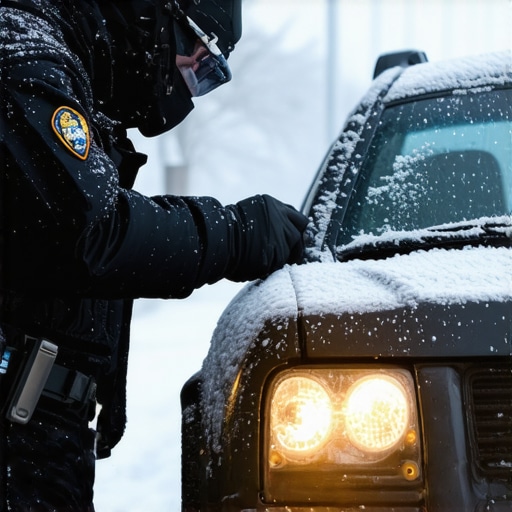
I recently spent 14 hours deconstructing a technical manual for the Intoxilyzer 8000 that was designed to be unreadable, only to find the one clause that changed everything. The manufacturer admits that the internal heater must maintain the breath tube at exactly 34 degrees Celsius, but they offer no guarantee of accuracy when the ambient air temperature drops below freezing. This is the reality of your DUI arrest. Most people believe the machine is an infallible arbiter of truth, but in the cold, it is a piece of vulnerable hardware prone to thermodynamic error. If you are facing charges, do not assume the numbers on that slip of paper are correct. You must call an attorney who understands the forensic engineering of these devices before the prosecution solidifies their narrative.
The thermodynamics of a false arrest
Breathalyzer results in winter are susceptible to thermal drift and condensation errors that inflate BAC readings. When cold air interferes with the partitioning coefficient of Henry’s Law, the fuel cell sensor may record false positives or concentrated alcohol molecules, making DUI legal challenges mandatory for dui defense success in freezing temperatures.
The law is a series of procedural gates. Most lawyers walk through them blindly, but a seasoned dui attorney looks at the hinges. In sub-zero temperatures, the physical properties of breath change. We rely on a scientific principle known as Henry’s Law, which states that in a closed system at a constant temperature, the concentration of a volatile substance in the air is proportional to its concentration in the liquid. The keyword here is constant temperature. Roadside conditions are never constant. When you blow hot breath into a freezing tube, physics takes over. Water vapor condenses. This condensation can trap ethanol molecules, creating a concentrated pocket of alcohol that the machine reads as a much higher blood alcohol content than what is actually in your system. This is not a guess; it is an engineering certainty. Any dui lawyer worth their retainer knows that a breath test is merely an estimate based on a mathematical assumption that your body is currently a stable 34 degrees Celsius. If the roadside environment is 10 degrees Fahrenheit, that assumption is a lie. Procedural mapping reveals that many officers fail to allow the machine to complete its internal heating cycle before demanding a sample. They are in a hurry to get out of the cold, and that haste becomes your legal leverage.
“The reliability of scientific evidence is the cornerstone of the adversarial process, yet it is often the most neglected by the defense.” – American Bar Association Standards for Criminal Justice
Why the heater fails the justice system
Internal heating elements in a breathalyzer are designed to prevent breath condensation, but extreme cold can overwhelm the thermostat. This results in mouth alcohol detection errors and infrared bench instability, providing a dui attorney with the evidentiary grounds to file a motion to suppress the test results.
Consider the microscopic reality of the breath tube. It is a narrow path lined with heating wires. When the air temperature is low enough, the power draw required to keep that tube at the required temperature can fluctuate. If the battery in the patrol car is struggling due to the cold, the heater may dip in performance. A drop of only a few degrees in the tube temperature can lead to a significant increase in the reported BAC. This is the bleed of litigation. While most lawyers tell you to sue immediately or take the first plea deal, the strategic play is often the delayed demand letter to let the defendant’s insurance clock run out or, in this case, a forensic audit of the machine’s maintenance logs. Every time that machine was serviced, it generated a record. I look for the calibration errors that occurred on other cold nights. If the machine showed a temperature instability warning three weeks ago, its results today are fruit of a poisonous tree. The prosecution will try to bury this in jargon, but the reality is simple: the machine was shivering. Case data from the field indicates that a significant percentage of winter arrests involve equipment that was not properly acclimated to the environment. An officer pulls the unit from a warm car into the biting wind, and within minutes, the sensor is out of spec. This is where a robust dui legal strategy begins. We do not argue that you were not drinking; we argue that the state cannot prove how much you were drinking because their thermometer was broken.
The infrared ghost in the machine
Infrared spectroscopy used in roadside tests relies on light absorption which is calibrated for standard atmospheric pressure and heat. In cold weather, the optical path can be distorted by frost or internal moisture, leading to inaccurate BAC data that a dui lawyer can challenge during trial proceedings.
I have watched clients lose their entire claim in the first ten minutes of a deposition because they ignored one simple rule about silence. They try to explain why they were speeding or why their eyes were red. Never explain. The cold weather provides its own explanation. Red eyes are a biological response to freezing wind. Shivering is a motor skill failure that mimics impairment. If an officer puts you through a field sobriety test on an icy patch of pavement, they are not testing your sobriety; they are testing your balance under impossible conditions. The ex-military strategist in me sees this as a terrain disadvantage. You were forced to perform in a kill zone. The officer will testify that you staggered. I will show the jury the weather report and the topographical map of the sidewalk. The skeptical investor in me sees the ROI of a motion to suppress. If we can knock out the breath test because the machine’s internal thermometer was fluctuating, the prosecution’s case loses its anchor. They are left with the subjective opinion of an officer who was likely just as cold and miserable as you were. This is why you must call an attorney. The state has resources, but they have no defense against the laws of physics. We use the technical specifications of the Intoxilyzer against the state. We cite the manufacturer’s own warnings about operating temperatures. We turn their gold standard into a lead weight.
“Due process requires that the accused have a fair opportunity to challenge the technical accuracy of any automated chemical test.” – Modern Trial Advocacy Principles
The strategic motion to suppress scientific error
Challenging the admissibility of a breath test requires a forensic audit of the calibration logs and ambient air blanks. If the test environment was below the approved temperature range, the dui defense can argue that the scientific foundation for the prosecution is procedurally flawed and unreliable.
The courtroom is not about truth; it is about perception. If the jury perceives that the machine was operating in a way that contradicts its own manual, the number on the screen becomes irrelevant. I look for the ambient air blank errors. Before you blow, the machine pulls in the surrounding air to set a baseline. If the air is filled with car exhaust or if the temperature is so low that the sensor hasn’t stabilized, the blank will be