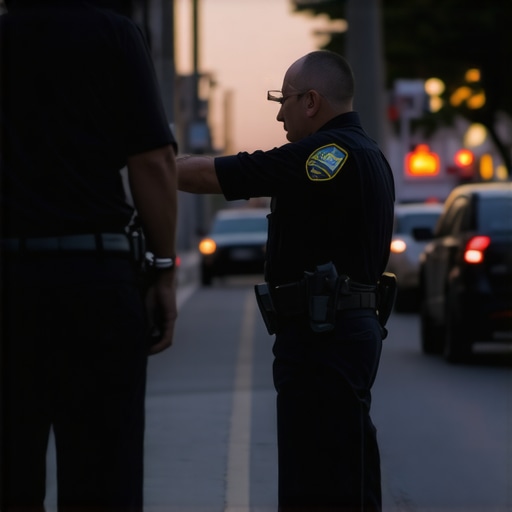
I watched a client lose their entire claim in the first ten minutes of a roadside interaction because they ignored one simple rule about silence. The air smelled of burnt rubber and cheap coffee. My client, a man with no criminal record, thought that by proving his balance, he could prove his innocence. He was wrong. The officer had already decided the outcome before the first instruction was given. In the world of high-stakes litigation, your cooperation is often your confession. This is the brutal truth of the roadside stop.
The ghost in the roadside evaluation
Field sobriety tests (FSTs) are not balance tests; they are divided attention tasks designed to create legal evidence for a DUI arrest. A dui attorney knows these tests are rigged to produce failure clues that a prosecution uses to justify a blood alcohol test. Case data from the field indicates that these evaluations are strictly subjective. The officer observes your ability to follow instructions while performing a physical act. If you start too early, it is a clue. If you use your arms for balance, it is a clue. The criteria are hidden from the driver but recorded with clinical precision by the state. You are being scored on a curve where the passing grade does not exist. The objective is not to see if you can drive. The objective is to gather the probable cause necessary to put you in handcuffs. Most people believe that performing well will let them go home. The reality is that the officer is merely checking boxes on a pre-printed form. This is why you must call an attorney immediately after any roadside interaction.
Anatomy of the horizontal gaze nystagmus trap
The Horizontal Gaze Nystagmus (HGN) test tracks the involuntary jerking of the eye as it moves peripherally. DUI defense attorneys argue that over 40 different natural causes, including caffeine or fatigue, trigger this response. Officers often fail to hold the stimulus at the correct 45 degree angle. Procedural mapping reveals that the HGN is the most scientific-looking test, yet it is the most prone to officer error. The stimulus must be held twelve to fifteen inches from the nose. The officer must move the stimulus at a specific speed, two seconds from the center to the side. If the officer is tired, or if the passing traffic is too fast, the eye may twitch due to optokinetic nystagmus, not alcohol. This is a physiological response that you cannot control. You cannot practice for it. You cannot beat it. The officer is looking for six specific clues. If they find four, you are legally presumed to be over the limit. This happens even if you are stone-cold sober but happen to have a slight inner ear imbalance or a high intake of nicotine that day. [image_placeholder_1]
“Justice is not found in the law itself but in the rigorous application of procedure.” – Common Law Maxim
Physical limitations disguised as criminal evidence
Standardized Field Sobriety Tests (SFSTs) assume a baseline level of physical fitness and neurological health. Factors like inner ear infections, back injuries, obesity, or even windy conditions can lead to a fail on the Walk and Turn or One Leg Stand despite zero blood alcohol content. A dui lawyer will look at the environment of the test. Was the ground level? Was there loose gravel? The National Highway Traffic Safety Administration (NHTSA) manual states that these tests should not be given to people with back, leg, or inner ear problems, or individuals who are fifty pounds or more overweight. Officers ignore these contraindications every single night. They see a stumble and call it intoxication. They see a shaky leg and call it impairment. They do not see the 2005 knee surgery or the vertigo caused by the flashing patrol lights. While most drivers think they must cooperate to prove innocence, the strategic play is the immediate refusal of non-mandatory tests to starve the prosecution of subjective evidence. You are not a gymnast. Do not let the state treat you like one.
The mathematical impossibility of officer scoring
NHTSA guidelines dictate specific clues for failure, but the arresting officer acts as judge and jury on the scene. If a driver misses a single instruction during a DUI defense scenario, they are marked with a clue. Two clues often lead to an immediate DUI arrest. The Walk and Turn has eight possible clues. You can fail by simply stepping off the line by half an inch. You can fail by taking ten steps instead of nine. You can fail by turning the wrong way. The instructions are delivered in a rapid-fire staccato designed to confuse. If you ask for clarification, that is often noted as a lack of comprehension, which is another indicator of impairment. It is a closed loop of logic. You are being tested on your memory and your physical coordination simultaneously under the extreme stress of a police encounter. No one performs at their peak when a flashlight is in their eyes and a badge is in their face. The scoring is binary: you are either perfect, or you are a criminal. There is no middle ground in the officer’s notebook.
“The individual’s right to protection from self-incrimination is the cornerstone of a fair trial.” – American Bar Association Journal
Evidence suppression through technical non-compliance
DUI legal strategy relies on the fact that officers are human and humans fail to follow instructions. A dui attorney will scrutinize the bodycam footage to ensure every word of the SFST instructions was delivered verbatim. If the officer skips a sentence, the test results may be suppressed. Procedural mapping reveals that technical errors occur in over 30 percent of arrests. The officer might forget to ask if you have any physical ailments. They might forget to tell you to keep your arms at your sides. These are not minor details. These are the legal foundations of your case. If the foundation is cracked, the entire prosecution can crumble. Your defense is built on the officer’s lack of discipline. We look for the gap between the manual and the reality of the midnight traffic stop. We look for the moment the officer became bored or frustrated. That is where we find the leverage to get a case dismissed or the charges reduced. The law is a game of millimeters.
Strategic delays in the demand for discovery
A dui attorney utilizes procedural mapping to challenge the dashcam footage and bodycam audio. While most people want to resolve cases quickly, the strategic play is a delayed demand for the calibration records of the breathalyzer to let the prosecution’s administrative clock run down. The state has limited resources. The more technical the defense becomes, the more likely the prosecutor is to look for an easier target. We demand the maintenance logs. We demand the officer’s training records. We demand the exact specifications of the flashlight used during the HGN test. We make the state work for every inch of their case. Most dui legal battles are won in the discovery phase, not the trial phase. By the time we get to court, we want the prosecution to realize that their evidence is a collection of subjective opinions and technical errors. This is the chess game of dui defense. You do not win by being nice. You win by being a procedural nightmare for the government.
The illusion of the voluntary roadside test
Law enforcement officers are trained to make field sobriety tests sound mandatory, but in many jurisdictions, they are completely voluntary. When you call an attorney, the first question they will ask is why you agreed to perform the tests at all. Requesting a dui lawyer before agreeing to any physical evaluation is a tactical necessity. The officer will tell you that the tests are your chance to prove you are sober. This is a lie. The tests are your chance to provide the state with the evidence they need to take your license and your freedom. The moment the lights go on, the investigation has begun. Every word you say is being recorded. Every movement you make is being judged. The only way to win a rigged game is to refuse to play. You have the right to remain silent and the right to an attorney. Use them. Do not let your desire to be a good citizen turn you into a convicted felon. The courtroom is a territory, and we are here to hold the line.