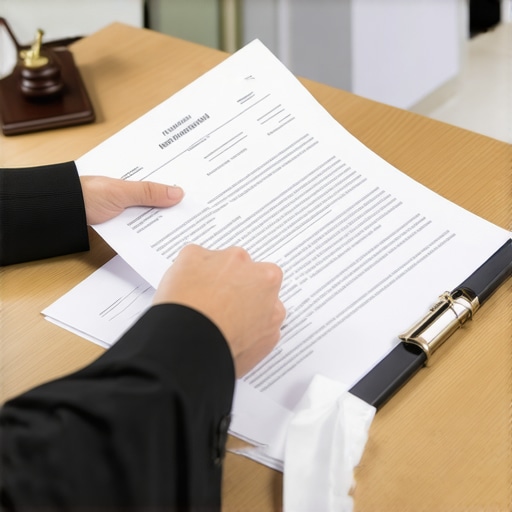
The silent clock ticking against your license
DUI legal strategies require an immediate understanding that your right to drive is currently on a timer that ends in mere days. A dui lawyer knows that the moment you were cited, the state began a process to revoke your privileges regardless of your guilt. You must call an attorney to file a formal request for an administrative hearing before the statutory deadline passes, which is often as short as seven to ten days. This is not about the criminal court case; it is a separate battle with the motor vehicle department that operates on its own rigid rules.
I smell the stale scent of strong black coffee as I look at another file where the client waited eleven days. Eleven days. That is one day too late. The law does not care about your commute, your job, or your family obligations once that window shuts. I have seen more cases lost at the mailbox than in the courtroom because people treat the administrative hearing like a suggestion. It is a mandatory hurdle. If you do not jump, you fall. This is the brutal truth of the system. The state wants to take your license because it is easy. It is a bureaucratic machine designed to prune drivers from the road with minimal resistance. Your dui defense starts with a piece of paper filed in a specific office, usually via certified mail, to prove you haven’t surrendered.
The mistake that ends the fight early
I watched a client lose their entire claim in the first ten minutes of a deposition because they ignored one simple rule about silence. They thought they could explain their way out of a bad situation. They couldn’t. In the context of an administrative hearing, the mistake is usually verbal. People talk to the hearing officer like they are a friend. They are not. The hearing officer is a representative of the state’s power. I recently handled a case where the driver admitted to ‘feeling the effects’ of a single drink during the initial stop. That admission, though seemingly minor, created a foundation of evidence that was nearly impossible to dismantle. Silence is your best asset until your dui attorney tells you otherwise. Procedural mapping reveals that the most successful outcomes happen when the defendant says nothing and let’s the evidence do the heavy lifting. The state has the burden, but you frequently give them the heavy lifting for free by opening your mouth.
The machinery of administrative license suspension
The administrative process is a cold, clinical environment that focuses on three specific questions: did the officer have reasonable suspicion to stop you, did they have probable cause to arrest you, and did you fail or refuse a chemical test? Case data from the field indicates that most drivers assume the ‘truth’ will save them. The truth is irrelevant if the procedure was followed. While most lawyers tell you to sue immediately, the strategic play is often the delayed demand letter or a specific focus on the calibration logs of the breath testing machine. We look for the gaps. We look for the minutes where the officer failed to observe you. If the officer turned their back to fill out paperwork during the twenty minute observation period, the test result is scientifically compromised. This is the microscopic reality of dui legal defense. It is not about a grand speech in front of a jury. It is about the technician failing to sign a logbook on a Tuesday afternoon three months ago.
“Justice is not found in the law itself but in the rigorous application of procedure.” – Common Law Maxim
The failure of the state to prove operation
The concept of operation is a specific legal entity that requires more than just sitting in a car. A dui lawyer will scrutinize whether the state can actually prove you were in actual physical control of the vehicle. I have seen cases where the keys were in the trunk, yet the officer still claimed the driver was ‘operating’ the vehicle. This is where we apply the pressure. We deconstruct the officer’s narrative word by word. Did they see the tires move? Was the engine warm? Was the key in the ignition? In many jurisdictions, the mere intent to drive is not enough to satisfy the administrative requirements for a suspension. We use these procedural nuances to create friction. The goal is to make it more difficult for the hearing officer to sustain the suspension than it is to simply grant the stay. Most people call an attorney too late to explore these tactical openings. They wait until the suspension is already active. Do not be that person.
[IMAGE_PLACEHOLDER]
The paperwork battle for your livelihood
The administrative hearing is not a trial with a jury and a robed judge. It is often a cubicle or a small conference room. It is a battle of paperwork. The officer’s sworn statement is the primary piece of evidence. If that statement contains a single material error, the entire foundation of the state’s case can crumble. We look for inconsistencies between the police report and the administrative affidavit. These are two different documents. Often, in the rush to finish a shift, an officer will copy and paste details that do not match the specific facts of your stop. This is where the dui defense finds its leverage. We are not looking for a moral victory. We are looking for a technical knockout. If the officer fails to appear at the hearing, we move for an immediate dismissal. If they show up, we trap them in the details of their own notes. This is the chess game of dui legal reality.
The cross examination of the arresting officer
When you get the officer on the stand in an administrative setting, you are not just asking questions. You are conducting a forensic audit of their memory and their training. You ask about the slope of the road where the field sobriety tests were performed. You ask about the lighting conditions. You ask about the specific brand of shoes the defendant was wearing. Why? Because the National Highway Traffic Safety Administration has very specific guidelines on how these tests must be administered. If the officer deviated by even a few inches in the placement of the feet during the walk and turn test, the results are technically invalid. An experienced dui attorney knows that officers are human. They get tired. They cut corners. Our job is to find the corners they cut and expose them under the harsh light of the hearing. It is a brutal process, but it is the only way to protect your license.
“The right to be heard has little meaning if it does not include the right to be heard in a meaningful time and in a meaningful manner.” – American Bar Association Guidelines
The reality of the restricted license outcome
Sometimes the win is not a total dismissal but the securing of a restricted permit that allows you to keep working. This requires a different kind of negotiation. We provide the state with a reason to be lenient. This involves a clinical breakdown of your driving record and the specific needs of your employment. The ‘bleed’ of litigation is expensive for the state too. If we show them we are prepared to fight every single point, they may be more inclined to offer a hardship license that keeps you on the road. This is the ROI of a good dui lawyer. We calculate the cost of you losing your job versus the cost of a vigorous defense. Usually, the defense pays for itself in the first month of kept employment. You cannot afford to be passive. The system is designed to process you, not to listen to you. You must force them to listen through high-level procedural maneuvering.
The necessity of professional legal intervention
You are standing on a crumbling ledge. Below you is a one year suspension, skyrocketing insurance rates, and the loss of your mobility. You can try to jump to the other side alone, or you can use a bridge. A dui attorney is that bridge. We understand the local statutes that are hidden in the back of the codebooks. We know the hearing officers and their specific biases. We know which machines in which precincts have a history of failing their self-calibration tests. This is not information you can find on a generic blog or a government website. This is the result of years in the trenches, smelling the coffee and reading the fine print. When you call an attorney, you are buying their experience and their tactical aggression. You are ensuring that the state has to work for every inch of ground they try to take from you. The hearing request is just the first shot in a very long war. Make sure you have someone who knows how to win it.