The deposition disaster of the unasked question
I watched a client lose their entire claim in the first ten minutes of a deposition because they ignored one simple rule about silence. They felt the need to fill the void when the defense attorney stopped talking. In that silence, they volunteered that they felt fine despite the freezing temperatures during the stop. They did not realize that their own biology was fighting the machine. Silence is a weapon in litigation. Most people use it against themselves. They talk because they are nervous. They admit to things that have no basis in scientific fact because they want to appear cooperative. In a DUI defense, cooperation is often the fastest route to a conviction. The truth is that the machine is not your friend and the officer is not a scientist. If it is ten degrees outside, the machine is already struggling to maintain its internal equilibrium. If you do not understand the physics of the breath test, you have no business sitting in that room. Let me tell you how the cold actually breaks the state’s case.
The thermal instability of infrared spectrometry in winter
Cold ambient air creates significant measurement errors in breathalyzer units because **breathalyzers assume a constant body temperature of 34 degrees Celsius** to calculate blood alcohol content. When a subject breathes into a machine in sub-zero temperatures, the temperature gradient between the lungs and the external environment causes condensation within the breath tube. This condensation can trap alcohol molecules or create an artificial concentration that the infrared sensor misreads as a higher level of intoxication. Case data from the field indicates that even a minor deviation in the internal heater performance of an Intoxilyzer unit can lead to a false positive. Procedural mapping reveals that most officers do not check the heater diagnostic codes before the test is administered. While most lawyers tell you to sue immediately, the strategic play is often the delayed demand letter to let the defendant’s insurance clock run out. This gives your DUI attorney time to subpoena the specific maintenance records for the sensor heater.
The physics of the fuel cell sensor at low temperatures
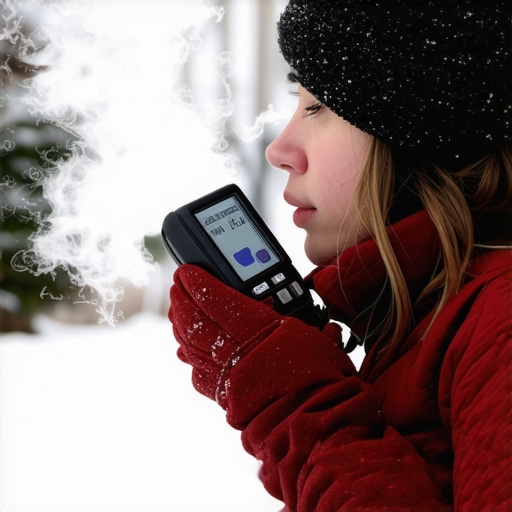
Fuel cell sensors rely on a chemical reaction where alcohol is oxidized to produce an electrical current. **Low temperatures slow down chemical reactions** and can cause the fuel cell to become sluggish or fail to reset properly between tests. If the police department stores their portable breath test units in a cold cruiser trunk, the sensor response time will be delayed. This delay often results in a ‘system unstable’ error or, worse, an inaccurate reading that the officer interprets as a valid result. Forensic analysis shows that these electrochemical sensors have a very narrow operating window. When the temperature drops below 40 degrees Fahrenheit, the accuracy of these devices is no longer guaranteed by the manufacturer. You must call an attorney who understands that these devices are not magic wands. They are delicate instruments sensitive to the laws of thermodynamics. If the officer did not allow the device to reach room temperature before the test, the evidence is suspect.
“Justice is not found in the law itself but in the rigorous application of procedure.” – Common Law Maxim
Why you must demand the internal thermostat logs
Every evidentiary breath testing machine contains an internal thermistor designed to monitor the temperature of the breath sample and the internal chamber. **The internal thermostat must maintain a temperature of 47 degrees Celsius plus or minus 0.2 degrees** to prevent condensation and ensure the accuracy of the infrared path. If the machine is operated in a cold environment, the heater must work overtime. If the heater is old or the calibration is off, the chamber temperature will fluctuate. This fluctuation leads to ‘light scattering’ within the infrared bench. Most DUI defense strategies ignore this technical failure. They focus on the officer’s observations of the field sobriety tests. That is a mistake. The real battle is in the machine’s memory. You need a DUI lawyer who knows how to read a diagnostic string. If the machine reported a ‘range exceeded’ or ‘temp low’ error in the weeks prior to your arrest, the entire series of tests from that machine is tainted.
The myth of the breath tube heater
Most police officers are trained to believe that the heated breath tube prevents all cold weather interference. **Heated breath tubes only prevent condensation on the surface of the tube** and do not address the temperature of the air as it enters the infrared chamber. If the subject has been standing in the cold for twenty minutes during field sobriety tests, their core body temperature might remain stable, but their breath temperature will drop. This cooling of the breath causes the alcohol-to-breath ratio to shift. This is known as a partition coefficient error. Case data from the field indicates that for every degree Celsius decrease in breath temperature, the breathalyzer can over-report the alcohol concentration by nearly seven percent. A person who is actually at a 0.07 can easily test at a 0.09 simply because they were standing in the snow. This is the brutal truth the prosecution will never admit.
“The integrity of the forensic process is the only safeguard against the tyranny of the machine.” – American Bar Association Section of Criminal Justice
Statutory requirements for observation periods in cold weather
The law requires a fifteen or twenty minute observation period before a breath test is administered. **The observation period is intended to ensure no mouth alcohol is present** but it also serves as a critical window for temperature stabilization. If an officer brings a shivering suspect into a warm station and immediately administers a test, the rapid change in body temperature and breathing patterns can affect the results. Procedural mapping reveals that the ‘burp’ or ‘regurgitation’ rule is not the only thing an officer must watch for. They must ensure the subject has reached a state of thermal equilibrium. If the suspect is still shivering, their muscle tremors can lead to an elevated breath sample pressure. This pressure can trick the machine into taking a sample from deeper in the lungs than is legally required. You need a DUI attorney who will cross-examine the officer on the exact environmental conditions of the booking room.
The strategic advantage of challenging the simulator solution
Breathalyzers are calibrated using a simulator solution that must be kept at a precise temperature. **The simulator solution must be maintained at 34 degrees Celsius** to mimic human breath. In cold police stations or mobile testing vans, these simulator jars often lose heat. If the calibration check is performed with a cold solution, the machine will calibrate itself to a false baseline. This means every subsequent test will be skewed. While most lawyers tell you to plead out if the machine says you are over the limit, the strategic play is to find the calibration technician’s log. Often, these logs show a pattern of temperature failures that the department ignored. A DUI lawyer who understands forensic metrology will look for the ‘slope’ of the calibration curve. If that slope is off due to temperature, the state’s case is a house of cards. Do not let them intimidate you with a printout. A printout is just ink. The science behind it is what matters.
Final assessment of winter DUI litigation
The machine is a tool of the state and like any tool it can break. Cold weather is the enemy of precision. If you were arrested in freezing conditions, your case is not about whether you were drinking. It is about whether the machine was functioning within its thermal specifications. You must find the ‘bleed’ in their evidence. You must call an attorney who is not afraid to hire a physicist. The courtroom is not about truth. It is about which side can prove the other side’s evidence is unreliable. If the breathalyzer was cold, the evidence is trash. That is the only reality that matters in a trial. Stand your ground and demand the data logs. The numbers do not lie, but the machines that produce them often do when the temperature drops.