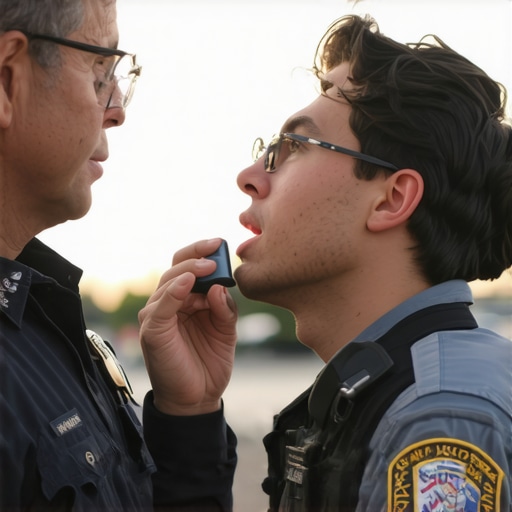
The Brutal Truth-Teller knows that your DUI case is likely failing before you even walk into the courtroom. Most people assume the breathalyzer is an infallible machine that measures the air deep in your lungs, but the reality is much more fragile. I watched a client lose their entire claim in the first ten minutes of a deposition because they ignored one simple rule about silence. They felt the need to fill the void with explanations that were not requested. In a DUI defense, specifically one involving residual mouth alcohol, the same principle applies. You cannot talk your way out of a breath test at the scene, but you can dismantle the scientific validity of that test in a courtroom if you understand the procedural failures of the arresting officer.
The science behind mouth alcohol interference
Residual mouth alcohol occurs when ethanol remains in the oral cavity or esophagus rather than coming from the alveolar air deep in the lungs. This phenomenon causes the breathalyzer to report a blood alcohol concentration that is artificially inflated. The machine is calibrated to assume a 2100 to 1 ratio between breath and blood alcohol, but that ratio falls apart if liquid alcohol is still present in your mouth. When you blow into that tube, the infrared spectrometry or fuel cell sensor detects the concentrated vapor from the mouth instead of the lower concentration from the pulmonary system. This creates a false positive that can lead to an arrest even if your actual blood level is well below the legal limit. Case data from the field indicates that even a tiny fraction of a milliliter of raw alcohol in the mouth can spike a reading from 0.04 to 0.15 in seconds. The machine cannot tell the difference between a glass of wine you just swallowed and the alcohol that has been processed by your liver and brain. It is a dumb instrument. It simply records the presence of molecules. If those molecules are lingering in your dental work, under a bridge, or trapped by a recent bout of acid reflux, the test is scientifically invalid. Most DUI defense strategies ignore this because they are looking for easy plea deals. A real trial attorney looks at the slope detector of the machine. The slope detector is supposed to identify a rapid rise and fall in alcohol concentration which indicates mouth alcohol, but these systems are notoriously unreliable in older Intoxilyzer models. If the slope detector failed to trigger an invalid sample error, the entire breath sequence is suspect. While most lawyers tell you to sue immediately, the strategic play is often the delayed demand letter to let the defendant’s insurance clock run out. This allows the defense to gather maintenance logs for the specific machine used in your case without alerting the prosecution to the specific angle of attack.
“Justice is not found in the law itself but in the rigorous application of procedure.” – Common Law Maxim
The twenty minute deprivation period requirement
The twenty minute deprivation period is a mandatory observation window where the officer must ensure the subject does not ingest or regurgitate anything. If the officer looks away to fill out paperwork or checks their laptop, the observation is broken and the test results should be suppressed. This is not a suggestion. It is a foundational requirement of forensic breath testing. Procedural mapping reveals that officers frequently cut this time short or fail to maintain continuous visual contact. They assume that if you are sitting in the back of the patrol car, the observation is happening. It is not. If you burp, hiccup, or even have a slight cough, the internal environment of the mouth is contaminated with stomach gases or liquid. The officer must restart the clock. In the courtroom, we zoom in on the dashcam or bodycam footage to count the seconds. If the officer was looking at their phone for thirty seconds, that is a thirty second gap in the observation period. That gap is where the reasonable doubt lives. The prosecution will argue that the officer was in the vicinity, but the law requires an unbroken period of observation to ensure that residual mouth alcohol has dissipated. This is the difference between a conviction and a dismissal. We examine the exact phrasing of the officer during the deposition. Did they see you swallow? Did they hear a gurgle? If they cannot answer with absolute certainty, the scientific foundation of the breath test is compromised. The machine assumes a sterile environment. The officer is the gatekeeper of that environment. When the gatekeeper fails, the evidence is tainted. We do not look for excuses; we look for the specific procedural lapse that makes the evidence inadmissible under the rules of evidence. This is the forensic psychology of the courtroom. We show the jury that the officer was lazy, and if the officer was lazy about the clock, they were lazy about the truth.
How GERD and acid reflux destroy breath test accuracy
Gastroesophageal Reflux Disease or GERD allows stomach acid and alcohol vapors to travel from the stomach back into the oral cavity. This creates a continuous supply of residual mouth alcohol that the 20 minute wait period cannot fix because the source is internal. For individuals with chronic heartburn or silent reflux, the breathalyzer is essentially a lottery. The machine detects the highly concentrated vapors from the stomach and treats them as if they came from the lungs. This is a physiological reality that no police officer is trained to diagnose. We use medical records to establish a history of esophageal issues. We bring in expert witnesses who can explain to the jury how a hiatal hernia or a weak lower esophageal sphincter creates a direct pipeline for alcohol to reach the sensor. The defense strategy involves showing that the client was a victim of their own biology. The prosecution will try to minimize this by saying the client did not look sick, but the Brutal Truth-Teller knows that the machine does not care about how you look. It only cares about the molecules passing through the infrared beam. If those molecules were pushed up by a silent reflux event seconds before the blow, the 0.08 reading is a lie. We look for the contrarian data point. Many people think a high reading means they are guilty. In reality, a high reading that does not match the physical sobriety of the defendant is the first sign of an RMA error. If you look sober on the field sobriety tests but blow a 0.18, that discrepancy is usually caused by mouth alcohol or a machine malfunction. We exploit that gap. We force the state to explain why a person with twice the legal limit is standing perfectly still on one leg. The answer is usually that the breath test is wrong.
“The integrity of the judicial system rests upon the strict adherence to the rules of discovery and the presentation of evidence.” – American Bar Association Standards
The hidden failure of the Intoxilyzer 8000 sensors
The Intoxilyzer 8000 uses infrared light to measure the concentration of alcohol but often fails to distinguish between ethanol and other interferents. This machine is a black box that the government treats as holy scripture, yet it is prone to software errors and sensor drift. In a residual mouth alcohol defense, we demand the COBRA data, which is the raw digital record of the breath test. This data often reveals the slope of the breath curve. If the curve is jagged or rises too sharply, it is a textbook indicator of mouth alcohol. Most lawyers never ask for this data because they do not know it exists. They rely on the printed slip of paper the police provide. That slip is the marketing brochure. The COBRA data is the autopsy report. We analyze the fuel cell stability and the temperature of the breath tube. If the tube is not heated correctly, condensation can form, which traps alcohol and introduces it into the next sample. This is the microscopic reality of the case. We look at the maintenance logs for the specific serial number of the machine. Has it been calibrated? Was it sent for repairs recently for sensor issues? If the machine has a history of failing its internal checks, we use that to create a narrative of technical incompetence. The court must understand that this is not a high-tech lab. It is a portable device kept in a dusty precinct or a vibrating patrol car. The logistics of the courtroom require that we attack the reliability of the tool itself. We show the jury that the state is relying on a machine that would not pass a high school science fair for accuracy. This is the flank attack. While the prosecutor talks about the law, we talk about the infrared spectrum and the failure of the electrochemical cell to differentiate between lung air and mouth vapor.
The strategic cross examination of the arresting officer
Cross examining the officer about the breath test requires a surgical focus on their lack of scientific training regarding residual alcohol. Most officers know how to push the buttons on the machine but have no understanding of the underlying physics or physiology. We ask them to define the partition ratio. We ask them to explain how the slope detector works. When they fail to answer, we have established that they are simply following a manual without understanding the consequences. This is the sensory anchor of the trial. The officer becomes the symbol of a flawed system. We ask about the specific conditions of the room where the test was taken. Was there a fan? Was there an smell of cleaning chemicals? Solvents and cleaning agents contain hydrocarbons that can trigger false positives on certain breathalyzers. This is the information gain that the prosecution fears. By introducing the possibility of environmental contamination, we broaden the scope of reasonable doubt. The jury begins to see the breath test not as a definitive number, but as a flawed estimate influenced by a dozen different variables. We use silence as a weapon. After an officer admits they did not check your mouth for jewelry or food particles, we let that admission sit in the air. The silence forces the jury to realize the magnitude of the error. Food trapped in dental work can act as a sponge for alcohol, keeping it in the mouth for hours. If the officer did not perform a physical check of the oral cavity, the 20 minute wait is irrelevant because the source of contamination was never removed. This is how you win a DUI case. You do not argue that you were not drinking. You argue that the state cannot prove how much you were drinking because their tools are broken and their procedures are sloppy. The Brutal Truth-Teller does not care about your feelings; they care about the leverage of the evidence. We build a wall of procedural failures and let the prosecution try to climb it. They usually fall.