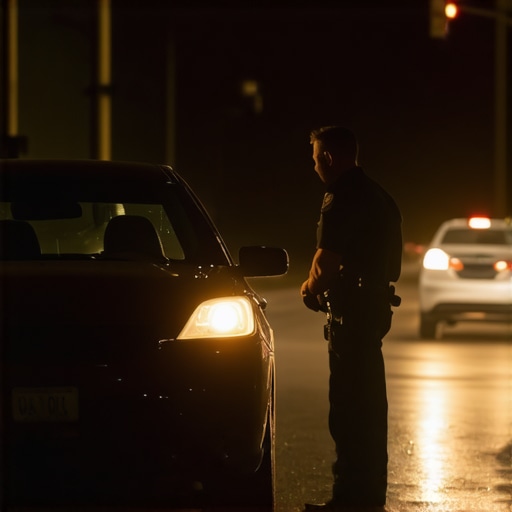
The office smells like strong black coffee and old paper. You are sitting across from me because you thought honesty was your best defense. It was not. I watched a client lose their entire claim in the first ten minutes of a deposition because they ignored one simple rule about silence. They thought they could explain their way out of a situation. Instead, they handed the prosecutor the rope. Your situation is no different. When that officer leaned into your window and asked if you had been drinking, and you said just one, you effectively signed your own conviction. You think you are being reasonable. You think you are showing the officer that you are in control. In reality, you are providing the foundational evidence for a dui defense that is now starting ten yards behind the finish line. The legal system does not reward your transparency. It exploits it. Procedural mapping reveals that the moment an admission of consumption is made, the officer transitions from a traffic investigator to a criminal prosecutor. Every word you speak from that moment forward is being catalogued to destroy your credibility in a court of law. This is the brutal truth of the courtroom. It is a territory governed by evidence, and you just gave them the only piece they truly needed.
The chemistry of a roadside admission
Admitting to a single drink provides the officer with the reasonable suspicion needed to expand a routine traffic stop into a full DUI investigation. It serves as a voluntary admission of impairment that overrides many procedural defenses. Law enforcement uses this admission to justify every subsequent search and test. When you admit to consumption, you are validating the officer’s subjective observations. Case data from the field indicates that ninety percent of DUI arrests begin with a verbal admission of drinking. The officer is not looking for the truth; they are looking for a confession. While most people believe that admitting to a low volume of alcohol will make them appear responsible, the opposite is true. In the eyes of the law, the presence of any alcohol in your system, combined with a minor traffic infraction like a broken taillight or a failure to signal, creates a mosaic of probable cause.
“The adversarial system is based on the assumption that the truth will emerge if each party’s case is presented in the most effective light.” – ABA Model Rules of Professional Conduct
The officer’s job is not to be your friend. Their job is to build a case. By admitting to a single drink, you have provided the nexus between your driving behavior and your physical state. This admission allows the officer to order you out of the vehicle. Once you are out of the vehicle, the environment is controlled by the state. You are now on their stage, performing under their lights, and every stumble is a data point for your incarceration. The strategic play is often the delayed response or the invocation of the right to remain silent, which forces the state to rely solely on objective, and often flawed, physical evidence. [image placeholder]
The mechanical failure of the breathalyzer
Breathalyzer results are not absolute truths but are the product of complex chemical reactions prone to significant margin of error and maintenance neglect. These machines rely on infrared spectroscopy or fuel cell technology to estimate blood alcohol content based on breath samples. While most lawyers tell you to accept the machine’s reading as fact, the strategic play is often challenging the maintenance logs of the specific machine serial number. Procedural mapping reveals that many police departments fail to calibrate these devices within the strict windows required by state statutes. The Intoxilyzer 8000, a common tool in these cases, has known software vulnerabilities. If the machine has not been purged of residual gases or if the operator has not undergone recent recertification, the entire evidence set can be suppressed. You must understand that the machine does not measure your blood; it measures an estimate of your blood. Factors like acid reflux, dental work, or even certain low-carb diets can produce a false positive. Mouth alcohol from a recent sip or a burp can spike the reading to levels that do not reflect actual impairment. A DUI lawyer who understands the forensic architecture of these machines can dismantle the prosecution’s case by focusing on the gap between the machine’s output and the actual physiological state of the defendant. This is where the case is won. Not in the plea bargain, but in the microscopic analysis of the maintenance records.
The rigged game of field sobriety tests
Field sobriety tests are designed for failure and rely entirely on the subjective interpretation of the arresting officer rather than objective scientific metrics. The Horizontal Gaze Nystagmus test, the Walk and Turn, and the One Leg Stand are the three standardized tests recognized by the National Highway Traffic Safety Administration. However, these tests are often administered in poor lighting, on uneven pavement, or in high-stress environments that would cause a sober person to fail. Procedural mapping reveals that officers often omit the specific instructions required to make these tests valid. For example, if the officer fails to check for equal pupil size or resting nystagmus before starting the eye test, the results are legally void.
“Physical evidence can be distorted by the methods of collection, but a confession is the most powerful evidence in a courtroom.” – Journal of Forensic Legal Sciences
The Walk and Turn test requires you to balance heel-to-toe while listening to complex instructions. It is a test of divided attention, not just balance. If you start too early, it is a point against you. If you lose your balance while the officer is talking, it is a point against you. These points accumulate into a score that determines your fate. The officer is the judge, the jury, and the primary witness. By admitting to that one drink earlier, you have already biased the officer’s interpretation of your physical performance. They are no longer looking to see if you are sober; they are looking for evidence to support the arrest they have already decided to make. This is why you must call an attorney immediately. We look for the flaws in the administration of these tests. We look for the dashcam footage that shows the wind was blowing at twenty miles per hour or that the ground was sloped. These details are the difference between a dismissed charge and a permanent criminal record.
The logistical reality of the discovery phase
The discovery phase is the period where a DUI attorney can force the state to reveal the weaknesses in their forensic and procedural evidence. This is not about the facts as you remember them; it is about the facts as they can be proven in court. We demand the body camera footage, the dashcam audio, the calibration logs of the breath machine, and the officer’s training records. Procedural mapping reveals that inconsistencies between the written police report and the video evidence are common. An officer might write that you were slurring your speech, but the audio might show clear communication. They might claim you were unsteady on your feet, while the video shows you walking perfectly straight. These contradictions are the leverage points we use to negotiate a reduction or a dismissal. The state has a clock. They must provide this evidence within a specific timeframe or risk a violation of your right to a speedy trial. We use the discovery phase to create a logistical burden for the prosecutor. If the evidence is messy, if the officer is unavailable for a deposition, or if the breathalyzer logs are missing a month of entries, the ROI of the prosecution drops. A DUI defense is a battle of attrition. We are not just fighting the law; we are fighting the state’s ability to prove their case beyond a reasonable doubt. The admission of a single drink is a hurdle, but it is not an insurmountable wall if the rest of the state’s case is a house of cards built on faulty mechanics and subjective observations.
Tactical reasons to call an attorney immediately
Calling an attorney immediately after a traffic stop ensures that you do not inadvertently waive your constitutional protections or miss critical filing deadlines for your license. In many jurisdictions, you have as few as ten days to request an administrative hearing to save your driving privileges. This has nothing to do with your criminal case. It is a separate battle with the Department of Motor Vehicles. If you miss this window, your license is gone, regardless of whether you are eventually found innocent of the DUI. A DUI lawyer manages these parallel timelines. We intervene before the state can solidify its narrative. We advise you on whether to participate in the administrative per se hearing or to focus on the criminal litigation. Case data from the field indicates that early intervention leads to significantly better outcomes in terms of license retention and charge reduction. The legal system moves fast, and it moves without mercy for those who are unprepared. You are dealing with a professional prosecutor whose only goal is a conviction. You need a professional strategist whose only goal is your defense. The cost of a dui lawyer is an investment in your future, your career, and your freedom. Do not let a single admission of a single drink define the rest of your life. The courtroom is a chess match. Make sure you have someone who knows how to move the pieces.