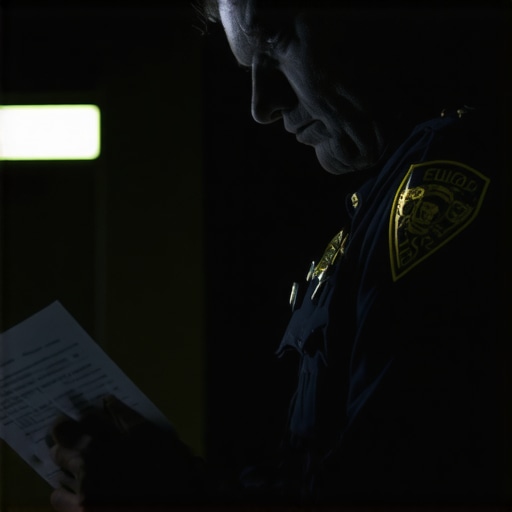
Sit down. Drink your coffee. If you are reading this, your life is likely in a state of administrative and legal collapse because a patrol officer decided your driving was impaired. You think the police report is a holy document of objective facts. It is not. It is a persuasive essay written by a state employee whose performance metrics often depend on the volume of arrests they secure. I have spent twenty-five years watching the machinery of the state grind people into dust based on reports that contain more fiction than a paperback thriller. I watched a client lose their entire claim in the first ten minutes of a deposition because they ignored one simple rule about silence, they thought they could explain their way out of a bad report. They could not. The officer had already written the ending to their story before the handcuffs were even clicked into place. If you want to survive this, you need to stop viewing the arrest record as a narrative and start viewing it as a forensic crime scene that we are going to deconstruct piece by piece. Your DUI defense depends on finding the holes in their logic. Call an attorney before you say another word to anyone.
The mechanical copy of the field sobriety checklist
DUI legal standards require that every field sobriety test be administered with surgical precision according to National Highway Traffic Safety Administration guidelines. If the officer’s report uses identical language for every single arrest, it suggests a lack of individual observation. Case data from the field indicates that officers often copy and paste descriptions of physical performance from previous reports to save time. This is the first red flag. When I see the exact same phrasing about a heel to toe turn in three different reports from the same officer, the credibility of the entire arrest vanishes. A real human being does not fail a test in a perfectly templated way. They stumble. They lose balance because of the wind or the uneven gravel on the shoulder of the road. If the report says you missed exactly three steps and started too soon without mentioning the forty mile per hour gusts of wind hitting your left side, the report is a lie of omission. We look for the lack of environmental context. A DUI lawyer knows that the absence of detail is just as damning as a false detail. Procedural mapping reveals that when an officer relies on boilerplate language, they are often hiding the fact that they did not actually observe the impairment they claim to have seen. The horizontal gaze nystagmus test is particularly susceptible to this. The officer must hold the stimulus twelve to fifteen inches from your nose. If the report does not specify the distance and the timing of the passes, the results are scientifically invalid. We look for the mention of the forty five degree angle. If that specific geometric detail is missing, the officer failed their training.
“The integrity of the criminal justice system depends on the accuracy of the record created at the moment of arrest.” – American Bar Association Standard
When the dashcam footage betrays the written word
A DUI attorney must immediately secure all available video evidence to compare the officer’s written narrative against the physical reality of the stop. Officers often describe a driver as swaying or stumbling, but the dashcam shows a person standing as still as a statue. This discrepancy is where cases are won. While most lawyers tell you to plead out early to avoid the hassle, the strategic play is often to wait for the digital discovery to prove the officer’s report is a fabrication. I have seen reports stating the driver was unable to stand without assistance while the video showed the driver leaning casually against their car with a cigarette. That is not just a mistake, it is perjury. The report might claim you had slurred speech, but the bodycam audio reveals clear, concise responses to every question. We look for the moment the officer’s pen hits the paper versus the moment the camera captures the event. If the report mentions a strong odor of alcohol but the officer is standing ten feet away from you in a high wind environment, the physics of the situation do not add up. The sensory claims in a DUI incident report are often the easiest to challenge because they rely on the subjective and unproven biological senses of a human being who is biased toward finding a crime. You need a dui defense that highlights these physical impossibilities. If the officer claims they smelled alcohol from a moving vehicle, we have a problem with their honesty. We zoom in on the timestamps. If the report says the stop occurred at 11:15 but the video shows the lights didn’t flash until 11:30, every action taken in those fifteen minutes is a constitutional violation.
The impossible physics of the officer’s sensory observations
Subjective sensory observations such as bloodshot watery eyes or the odor of an alcoholic beverage are standard tropes used in every DUI incident report. These phrases are designed to provide the reasonable suspicion necessary to expand a simple traffic stop into a full blown criminal investigation. Procedural mapping reveals that these descriptions are often added after the fact to justify an arrest that was already decided. My job is to ask why those eyes were bloodshot. Were you wearing contacts for sixteen hours? Do you have seasonal allergies? Is there smoke in the air from a nearby wildfire? The officer never asks these questions because they don’t want the answers. They want the conviction. The report will almost always say the odor was strong. It is never faint. It is never moderate. It is always strong. This is a linguistic trick used to bypass the need for more concrete evidence. A DUI lawyer will tear this apart by looking at your medical history. If you suffer from Gastroesophageal Reflux Disease, your breath might smell like alcohol even if you haven’t had a drink in days. The officer’s report will ignore this biological reality because it doesn’t fit the script. We look for the description of your face. Was it flushed? That could be high blood pressure or simple anxiety from being pulled over by an aggressive officer. If the report fails to mention your physical state prior to the stop, it is an incomplete and biased record. We investigate the lighting conditions of the scene. If the officer claims your pupils were dilated but they were shining a high intensity flashlight directly into your retinas, their observation is medically impossible.
Why the timestamp is your strongest defensive weapon
Timeline discrepancies in a police report can invalidate the results of a breathalyzer or blood draw by breaking the strict observation period rules. Law enforcement must observe a suspect for twenty continuous minutes before administering a breath test to ensure no mouth alcohol is present. If the report shows the arrest at 12:01 and the test at 12:15, the officer has admitted to violating the law. This is the microscopic reality of litigation. Most people don’t look at the minutes. I look at the seconds. I look at the time it took to transport you to the station. If the drive takes ten minutes and the observation period supposedly took twenty minutes, but the total time elapsed is only fifteen minutes, the report is a mathematical failure. This is why you call an attorney who understands the logistics of the precinct. We know how long it takes to process a suspect. We know how long it takes for the machine to warm up. If the internal clock of the Intoxilyzer 8000 does not match the officer’s watch, we have a window of doubt. Case data from the field indicates that officers frequently fudge these numbers to make the paperwork look clean. They are not expecting a defense team to map the transit time between the highway marker and the booking desk. We look for the gap. If there is a five minute window where the officer was not watching you because they were filling out paperwork or talking to a colleague, the breath test is legally dead. Procedural integrity is not a suggestion; it is a requirement. The state must prove they followed every second of the protocol.
“Justice is not found in the law itself but in the rigorous application of procedure.” – Common Law Maxim
The curious case of the missing exculpatory facts
Exculpatory evidence is any information that tends to prove the innocence of the defendant, and its omission from a DUI report is a violation of due process. If you performed the walk and turn test perfectly for the first seven steps but stumbled on the eighth, a biased officer will only record the stumble. They will completely omit the fact that you followed all instructions and maintained perfect balance for ninety percent of the test. This is the definition of a settlement mill approach to law enforcement. They give the prosecutor only the